Shopify Plus vs commercetools: Which Enterprise Commerce Platform Actually Fits Your Business?
If you’re comparing Shopify Plus vs commercetools, you’re probably asking whether you want a platform that helps you move fast with less technical overhead, or one that gives you maximum architectural control, even if that means more responsibility, more integration work, and more ongoing ownership.
Shopify Plus and commercetools can both support enterprise commerce, but they win in different environments. Shopify Plus is a managed commerce platform designed to reduce operational burden and speed up execution. Commercetools is an API-first, composable commerce engine built for organizations that want to design commerce around their own systems, processes, and business models.
This breakdown focuses on what usually drives the decision in the real world: pricing model, operational reality, and the reasons brands switch in either direction.
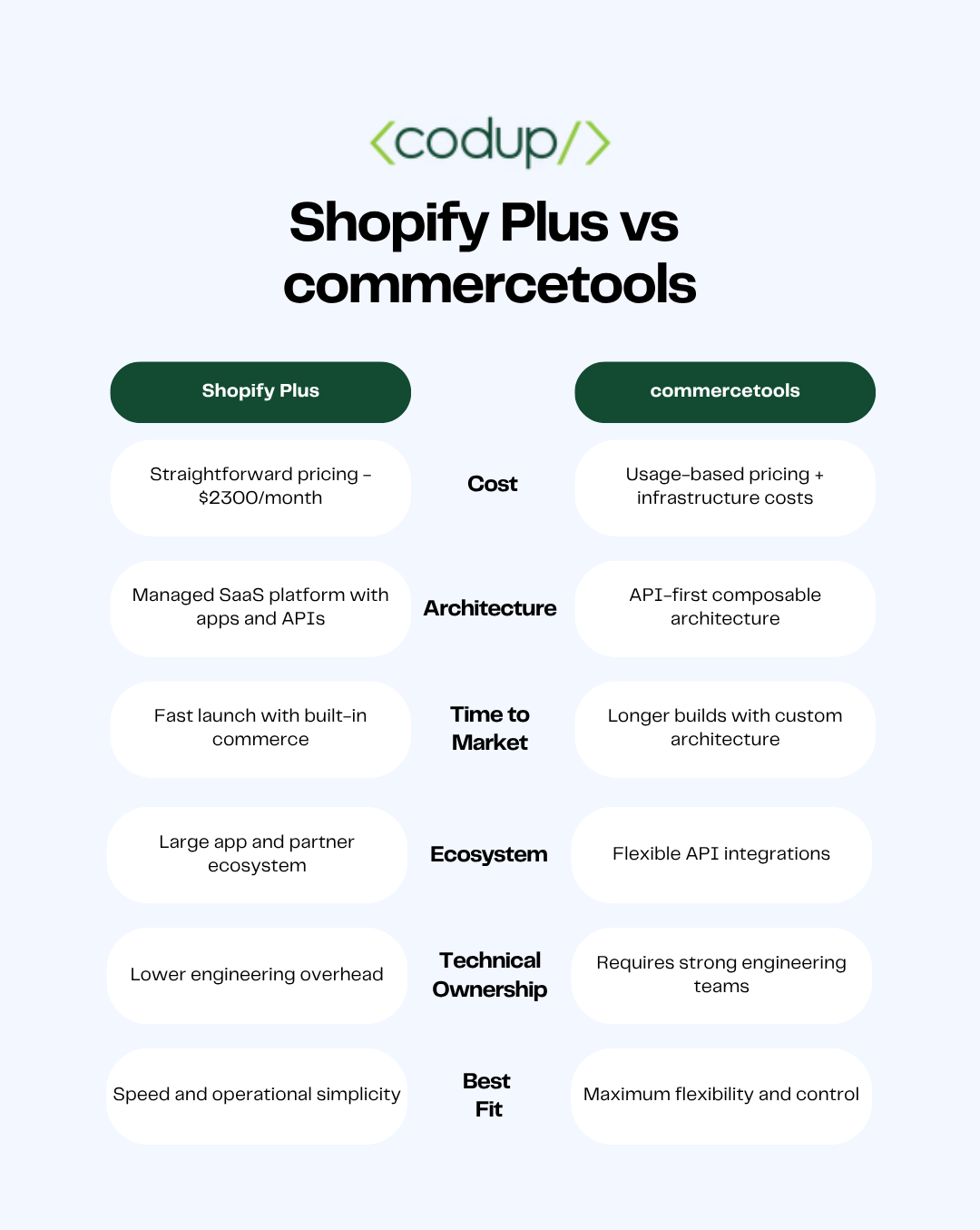
Shopify Plus Pricing vs commercetools Cost Model
Shopify Plus: Predictable subscription + ecosystem costs
Shopify Plus is typically a fixed subscription model with a predictable baseline cost. Hosting, performance, security posture, and platform upgrades are included.
The reason enterprises like this model is simple: you can forecast it. You might spend more on experiences and integrations, but you’re not rebuilding foundational commerce plumbing just to stay current.
commercetools: Usage-based licensing + build/operate costs
Commercetools is typically usage-based (often tied to order volume and/or API usage) and is designed to sit inside a broader composable stack. That changes the cost conversation.
With commercetools, the license is only one part of the equation. The rest usually includes:
- Implementation (architecture + development)
- Integrations (ERP, tax, search, CMS, promotions, personalization, etc.)
- Hosting / cloud costs (depending on setup)
- DevOps, monitoring, security ownership
- Ongoing maintenance across multiple services
In short, commercetools can be the right long-term play when you genuinely need composability. Still, the TCO is heavily influenced by how much you’re building and how many systems you’re orchestrating.
Key Differences Between Shopify Plus and commercetools
1) API-First Architecture and flexibility
Shopify Plus provides a mature SaaS core with well-defined extension points. You can go headless (Hydrogen/Oxygen or custom), and you can build a lot—لكن you’re still operating within Shopify’s platform constraints, especially around checkout and specific backend workflows.
Commercetools is composable by design. You’re essentially assembling your commerce system through APIs and services. The upside is freedom. The trade-off is that you own the architecture and the operational complexity that comes with it.
- If your commerce is “standard but scaled,” Shopify Plus usually wins.
- If your commerce is “non-standard by nature,” commercetools becomes compelling.
2) Time-to-market vs long-term control
Shopify Plus tends to win on time-to-market because you’re leveraging an existing platform plus a vast ecosystem.
Commercetools tends to win on tailored outcomes because you’re designing a fit-for-purpose commerce engine—but that means longer delivery cycles and more planning.
A good rule of thumb:
- Shopify Plus is best when you’re optimizing for speed, agility, and operational simplicity.
- Commercetools is best when you’re optimizing for control, differentiation, and complex business models.

3) Scaling and performance
Shopify Plus is built to absorb traffic spikes and operational load without your team managing infrastructure tuning day to day. For most enterprise brands, Shopify’s scale is more than sufficient.
Commercetools’ microservices approach can be a strategic advantage when:
- Your traffic patterns are highly variable
- Your catalog/checkout workflows are extremely custom
- You need independent scaling across services
- You want to optimize specific backend components without moving the whole platform.
Shopify’s scaling is rarely the limiting factor. The limiting factor is usually platform constraints vs your required workflows.
4) Ecosystem and extensibility
Shopify Plus has a massive ecosystem of apps, partners, and prebuilt integrations. That can compress delivery timelines dramatically.
Commercetools has a different kind of extensibility: API-first integration freedom. But that also often means more custom integration work, because there isn’t the same “app marketplace” approach.
5) Internal team requirements
This is where many decisions are actually made.
Shopify Plus is easier to run with a leaner technical team because the platform handles much of the “commerce ops” complexity.
Commercetools typically requires more substantial internal engineering ownership—architects, backend engineers, DevOps maturity, and a clear product operating model—because you’re managing more moving parts.
Why Brands Switch from Shopify Plus to commercetools
Wild Fork Foods: When eCommerce is more complex than what Shopify can handle
Wild Fork Foods sells products that don’t behave like normal eCommerce SKUs. Prices change with weight, inventory is constantly moving, and much of the logic lives in backend systems like ERP systems. Early on, Shopify helped them move fast and get online quickly. That part worked.
But as the business grew, the cracks started to show. Handling variable-weight products, properly syncing prices, and keeping online and offline systems in lockstep meant building more and more workarounds. The team wasn’t just building features anymore — they were constantly bending the platform to make it do things it wasn’t designed for.
That’s where commercetools made sense. It gave them the freedom to design the commerce logic around how the business actually works. Pricing, inventory, and integrations could be handled cleanly instead of patched together. It wasn’t a more straightforward setup — but for a company this complex, control mattered more than convenience.
Why Brands Switch from commercetools to Shopify Plus
Daniel Wellington: Too Much Flexibility Slowing Things Down
Daniel Wellington is a good example of a brand realizing it had gone a bit too far with flexibility.
On commercetools, they could build almost anything — but every change took time. Launching new stores, rolling out updates, or adjusting workflows meant coordinating across multiple systems and teams. Over time, speed started to suffer.
Moving to Shopify Plus helped simplify things. They reduced the number of storefronts, leaned on Shopify’s built-in capabilities, and got back to shipping faster. They didn’t move because they needed more power — they moved because they wanted less friction.
Final Verdict: Shopify Plus vs commercetools
There’s no “better” platform here. There’s only a better fit for how your business actually works.
If your goal is to move fast, launch markets quickly, and keep your tech stack simple, Shopify Plus development is the right choice. It takes a lot of heavy lifting off your plate, such as hosting, security, checkout, and scaling, so your team can focus on growth instead of maintaining infrastructure. For most DTC and even many enterprise brands, this is more than enough.
Commercetools makes sense when commerce itself becomes complex. If pricing, inventory, fulfillment, or customer logic can’t fit into a standard model and your business already runs on custom systems, then the extra control is worth the extra effort. But that flexibility comes with responsibility: more engineering, more integrations, and more long-term ownership.
The mistake teams make is choosing based on what sounds more “enterprise” or more “future-proof.”
The right question is more straightforward:
- Do you want a platform that gets out of your way so you can execute?
- Or do you want one that lets you design everything yourself, even if it slows you down?
The best commerce platform is the one your team can run confidently, improve continuously, and scale without fighting it every day.

Other eCommerce platform comparisons:
- B2B eCommerce Platforms: BigCommerce vs Shopify vs Adobe Commerce
- Shopify Plus vs Salesforce Commerce Cloud
- Shopify Plus vs BigCommerce Enterprise: Choosing the Right Platform for Scale