Dealer E-commerce Portal For Better Channel Partner Relationships

In this guide, we’ll explore why manufacturers are investing in dealer portals, what defines a high-performing dealer portal for manufacturers, and how the right platform can strengthen channel partner relationships while enabling your partners to sell more – and sell faster.
For decades, manufacturers have invested heavily in product innovation, supply chain efficiency, and sales teams, yet the very partners responsible for bringing those products to market are often left navigating outdated processes.
Consider a simple, everyday scenario.
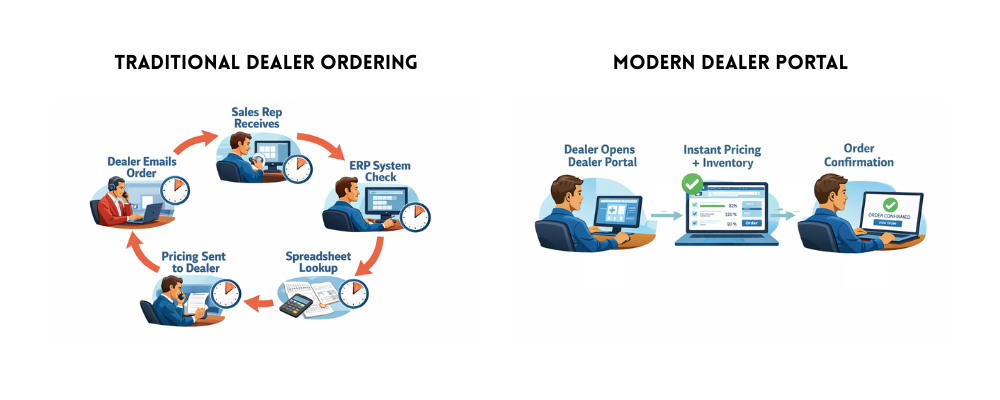
A dealer needs to quote a customer for a specific product. Traditionally, that process means calling a sales rep or sending an email to confirm pricing and availability — then waiting. And waiting. Meanwhile, their customer is expecting an answer now.

In a world where speed and convenience define buying behavior, do you think that customers will patiently stay on the line? Or will they move on to another supplier who can respond instantly?
Channel partners are expected to sell faster, quote accurately, and compete in an Amazon-shaped market. Yet many are still relying on email threads, static PDFs, and manual back-and-forth.
When it’s harder to do business with you than with a competitor, partner loyalty will erode.
Today’s leading manufacturers understand that strengthening channel partner relationships requires more than incentives and handshake agreements. It requires infrastructure.
A modern dealer e-commerce portal gives distributors, resellers, and dealers a faster way to buy, market, and sell, all within a single secure digital environment.
A well-designed B2B dealer portal is not just an ordering system; it’s a revenue enablement engine. It centralizes real-time pricing, inventory visibility, marketing assets, order history, and contract-specific terms into a single hub, empowering partners to move quickly and confidently.

The Channel Relationship Bottleneck
Manufacturers don’t sell directly; they sell through channel partners.
Your growth depends on how effectively dealers, distributors, and resellers can represent your products in their markets. But in many organizations, the very systems meant to support those partners are quietly slowing them down.
Most channel relationships are still burdened by:
- Email-based ordering
- Outdated price sheets
- Scattered marketing materials
- Manual approval workflows
- ERP data locked away inside internal systems
Dealers are trying to sell faster than manufacturers enable them to.
When a partner has to wait for pricing confirmation, search through inboxes for product specs, or request marketing assets manually, you’re limiting their ability to compete.
And when a competitor offers faster quoting, clearer visibility, and easier ordering, loyalty begins to shift.
Today, loyalty isn’t built through handshakes. It’s built through enablement.
A modern B2B dealer portal is the infrastructure that determines whether channel partners thrive or gradually drift toward suppliers that are easier to work with.
The right dealer ecommerce portal strengthens relationships by making it easier for channel partners to win in their markets.
What Is a Dealer Ecommerce Portal?
A dealer e-commerce portal is a secure, login-based digital platform designed specifically for dealers, distributors, and resellers. It’s a centralized commerce and enablement platform where channel partners can:
- Access negotiated pricing and contract terms
- Check real-time inventory and availability
- Place and track orders
- Download marketing and technical materials
- Manage returns and warranty requests
- Participate in promotions or rebate programs
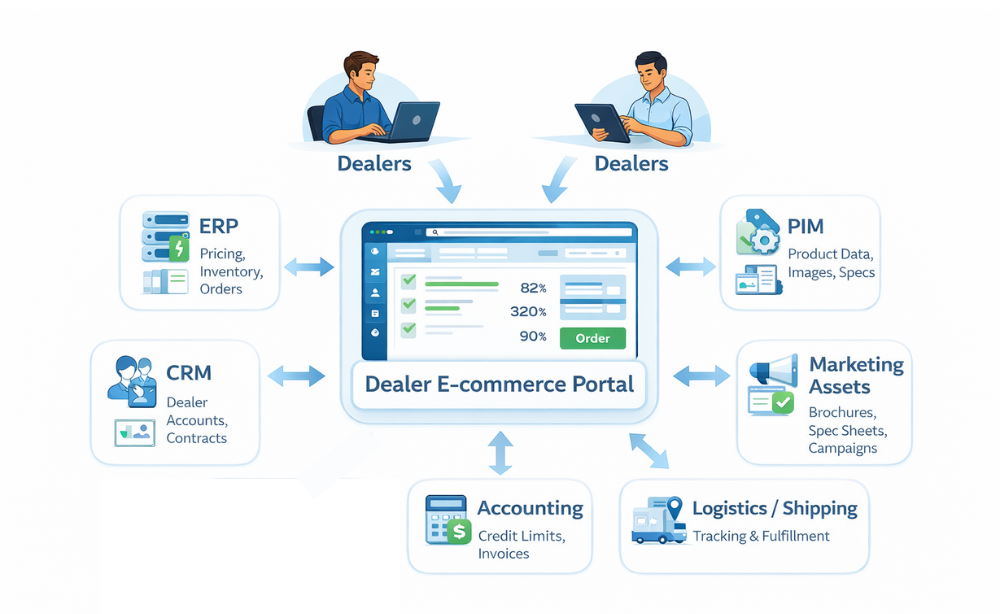
Behind the scenes, the portal integrates directly with critical backend systems, including ERP, CRM, PIM, and accounting platforms, ensuring that pricing, inventory, order status, and product data are always accurate and synchronized.
A true dealer portal for manufacturing combines commerce, marketing, and operational workflows into one cohesive system.
It enables dealers not just to buy, but to sell.
By centralizing product data, pricing rules, order history, inventory visibility, marketing resources, and program management into one structured hub, the portal becomes the first place dealers go to check a price, confirm availability, download a spec sheet, launch a campaign, or place a bulk order.
Core Capabilities of a B2B Dealer Portal That Strengthen Channel Partner Relationships
A high-performing dealer ecommerce portal provides partners with speed, clarity, and confidence, enabling them to market more effectively and sell more effectively.
Here are the essential features that truly enable dealers and partners to sell your products more effectively and make it easier for them to work with you.
Real-Time Commerce Infrastructure
Channel partners cannot sell confidently if they are unsure about pricing or availability.
A modern B2B dealer portal must provide:
- Live pricing synced directly from ERP
- Territory-specific and contract-based pricing
- Region-based catalog visibility
- Real-time inventory visibility across warehouses
- Backorder transparency
- Accurate lead times
- Bulk ordering functionality
- CSV/spreadsheet uploads
- BOM rules and configurable product logic
- Mixed unit-of-measure handling
- Automated unit conversions
If each dealer sees a different price list or regional assortment, your platform must handle that through rules — not through spinning up separate portals.
For example, a construction supplier can operate one backend while serving seasonal assortments in certain regions and core ranges in others — all without duplicating product data.
When pricing and inventory are always accurate, deals move forward rather than stall.
Direct, Reliable Data Connections
The lifecycle of a B2B dealer portal depends on its trustworthiness.
If inventory shows “available” when it’s not, or product specs are outdated, dealers stop logging in.
Your portal must pull live data from:
- ERP (pricing, stock, orders)
- PIM (marketing-ready product content)
- CRM (account and contract data)
- Accounting systems (credit limits, invoices)
PIM integration is especially critical. Dealers need:
- Accurate descriptions
- High-resolution images
- Spec sheets
- Attributes
- Compliance documentation
- Marketing-ready content
When product data is clean, structured, and centrally managed, dealers can confidently market and sell without second-guessing information.
For certain enterprise buyers, PunchOut integration may also be essential — allowing dealer systems to connect directly to procurement platforms for streamlined purchasing.
Order Handling Built for Scale and Complexity
Dealer orders are rarely simple.
They often involve hundreds of SKUs, mixed packaging units, configured kits, contract rules and approval thresholds.
Your dealer portal must support:
- Bulk uploads
- BOM logic
- Automated validation
- Rule-based discount control
- Automated approval workflows
- AI-powered PO processing
- Orders flowing directly into fulfillment systems
This reduces internal overhead and increases repeat purchasing velocity.
Centralized Marketing & Sales Enablement Hub
A portal that handles only orders is ignored between purchases.
Dealers don’t just need products.
They need tools to sell those products.
A high-impact dealer portal should include:
- Integrated marketing resource library
- Co-branded assets
- Campaign toolkits
- Product launch kits
- Rebate and incentive programs
- In-portal promotions
- Training materials
- Certification programs
- Technical documentation
- Updated spec sheets
This dramatically strengthens channel relationships because you’re not just supplying inventory — you’re enabling revenue.
Personalized Dashboards & Performance Visibility
Transparency builds trust.
Your portal should provide:
- Custom dashboards per dealer
- Open orders
- Credit limits
- Sales performance
- Territory metrics
- Program participation tracking
- Parent-company and branch-level visibility
- Reporting views tailored to role
Structured Channel Governance Without Micromanagement
As dealer networks grow, control must scale without becoming a maintenance nightmare.
A strong dealer portal for manufacturing should support:
- Role-based permissions
- Branch-level access control
- Parent-child hierarchies
- Purchasing limits
- Approval thresholds
- Discount governance
- Custom catalog restrictions
- Audit trails
Each user should see only:
- The products they are authorized to buy
- The pricing negotiated for them
- The programs available to their region
- The reports relevant to their role
This ensures consistency across the channel while preserving flexibility for complex structures.
Deep System Integrations That Unify the Channel
The portal must sit on top of your infrastructure, not operate separately from it.
Essential integrations include:
- ERP synchronization
- CRM sync
- Accounting integration
- Payment gateway integration
- Logistics tracking
- PIM connectivity
- API extensibility
- Automated cross-system workflows
- Optional PunchOut integration
When data flows seamlessly, dealers trust what they see and channel complexity becomes manageable.
When these capabilities work together, the dealer ecommerce portal stops being “another system.”
It becomes the place your channel partners go first — for pricing, inventory, marketing, promotions, training, and ordering.
And when that happens, your brand becomes the one they sell first.

How to Design a B2B Dealer Portal That Actually Gets Used
The biggest mistake manufacturers make isn’t choosing the wrong software — it’s launching a portal that looks impressive in a demo but doesn’t align with how dealers actually work.
A dealer ecommerce portal only strengthens channel relationships if it becomes part of your partners’ daily workflow. That requires planning around real-world behavior, not feature lists.
Here’s how to do it properly.
Map Current Dealer Workflows
Before discussing platforms or integrations, document how dealers interact with you today.
Ask:
- How do they request pricing?
- How do they check inventory?
- How do they place bulk orders?
- How do they access marketing assets?
- How do they enroll in promotions or rebates?
- Where do delays typically occur?
If a bulk order still requires emailing a spreadsheet and waiting for someone to key it into the ERP, that’s your first automation opportunity.
Identify High-Friction, High-Impact Use Cases
Not everything needs to be solved on day one.
Focus first on dealer tasks that:
- Occur frequently
- Cause delays
- Impact revenue
- Generate repeated support requests
Common high-impact starting points include:
- Real-time price and inventory checks
- Bulk ordering tools
- Order tracking
- Access to updated spec sheets
- Quick reorders
By prioritizing these workflows, your B2B dealer portal delivers immediate value and proves its relevance.
Audit Product Data Quality
Even the best portal fails if the data feeding it is unreliable.
Evaluate:
- Is ERP inventory data accurate and real-time?
- Is pricing logic consistent across dealer tiers?
- Is product content centralized in a PIM?
- Are specifications and images marketing-ready?
- Are units of measure standardized?
Dealers will only trust the portal if what they see is always correct.
If inventory says “available” but isn’t, adoption drops instantly.
Data trust is the foundation of dealer adoption.
Pilot With a Small Dealer Segment
Avoid launching across your entire network at once.
Select one region or one product line.
A controlled pilot allows you to:
- Test pricing logic
- Validate integrations
- Identify workflow gaps
- Collect real feedback
- Refine usability
Early feedback from real dealers is more valuable than internal assumptions.
Build an Adoption Strategy – Not Just a Launch Plan
A dealer portal is not self-adopting.
To ensure usage:
- Communicate the value clearly
- Provide onboarding training
- Offer quick-start guides
- Assign a portal owner internally
- Track adoption metrics (logins, orders, downloads)
- Incentivize usage during early phases

Ready to Strengthen Channel Partner Relationships?
If your dealers are still relying on email threads, static PDFs, and manual updates, your dealers are operating below their potential.
Let’s build a dealer ecommerce portal that enables your partners to sell more, faster, and with confidence.