15 Real B2B Portal Examples That Improve Dealer and Customer Experience

The best B2B portal examples in this article all start from the same place: a manufacturer or distributor doing things manually, absorbing the cost, and eventually replacing friction with self-service. In every case, the results went beyond efficiency and they changed how the business grew.
This guide covers 15 real companies that built B2B portals and saw measurable results. Some are mid-size manufacturers you may not have heard of. Some are household names. All of them made it easier for buyers to do business with them and came out ahead for it.
What Makes a Good B2B Portal (Before the Examples)
A B2B portal is not a website with a login page. It’s a secure, role-based environment where your customers, dealers, distributors, wholesale buyers, or end-business customers can manage their entire relationship with you digitally. That means:
- Placing and reordering without calling a rep
- Seeing their specific contract pricing, not your generic catalog
- Tracking orders and pulling invoices in real time
- Managing accounts, approvals, and multiple locations
- Getting answers without contacting your support team
The key capability is self-service. Every call your CS team doesn’t have to take, every email your order desk doesn’t have to process, every manual data entry that doesn’t happen is the real ROI of a well-built B2B customer portal.
It also needs to connect to your backend systems: SAP ERP, WMS, OMS, pricing engine. A portal that shows yesterday’s inventory or approximate pricing isn’t a portal, it’s a liability.
With that framing, here are 15 B2B portal examples across manufacturers, distributors, and wholesalers, grouped by the problem they solved.
Also read: How to turn your B2B portal into a High-converting sales machine?

9 B2B Portal Examples of Successful Implementations
1. Caterpillar — A Dealer Portal at Global Scale
Industry: Heavy equipment manufacturing Platform: Proprietary / Cat Integrated Procurement (Cat IP)
Caterpillar operates a dealer network spanning over 190 countries and nearly 180,000 dealer employees worldwide. Their approach to the dealer portal experience is built around one principle: meet each buyer type at whatever level of integration they need.
For standard dealers, the Cat Parts Store allows 24/7 parts ordering with real-time availability and multiple delivery options. For large enterprise customers with complex procurement environments, Cat Integrated Procurement (Cat IP) goes further — connecting directly to the dealer system to generate automatic, real-time work orders when customers place parts orders from within their own internal procurement systems. No duplicate data entry. No re-keying. The customer’s procurement system and the Cat dealer portal talk directly to each other.
This isn’t a single B2B portal — it’s a tiered digital ecosystem where different buyer types get different levels of integration, all pointing back to the same dealer network and parts inventory.
Key takeaway: At enterprise scale, one-size-fits-all B2B portal design breaks down. Offering tiered access — basic self-service for standard buyers, deep system integration for enterprise accounts — lets you serve every customer type without compromising the experience for any of them.
2. InHealth Technologies — Getting Inventory Data You Can Actually Trust
Industry: Medical devices / voice restoration products Platform: SAP + Corevist
InHealth Technologies makes voice restoration products sold through a specialist distributor network. The problem wasn’t their product, it was their portal. It existed, but it wasn’t connected to their SAP ERP in real time. Customers would place orders based on what the portal showed, only to find out inventory didn’t match. Customer service reps ended up manually verifying every order in SAP and communicating back and forth with customers to confirm availability.
It was a trust problem as much as an efficiency problem. If buyers can’t trust what your B2B portal shows, they stop using it.
After implementing a portal with live SAP integration, InHealth solved this at the source. Every inventory figure, every price, every order confirmation is now pulled directly from SAP in real time. Customers place orders with confidence. CS reps are no longer in the middle of every transaction.
Key takeaway: A B2B portal is only as useful as the data it shows. If it’s not connected to your ERP, it’s creating more problems than it solves.
3. Emmerson Packaging — Recovering Self-Service After an ERP Migration
Industry: Flexible packaging manufacturing Platform: SAP + Corevist
ERP migrations are disruptive by definition. For Emmerson Packaging, the move to SAP also killed their existing customer portal, which had been built on their legacy system and couldn’t survive the transition. Overnight, every customer interaction reverted to phone and email.
For a manufacturer dealing with complex order creation workflows and stock release processes, it created serious operational strain and eroded the self-service experience their customers had come to rely on.
Emmerson rebuilt their B2B portal with native SAP integration, restoring full self-service capability including complex ordering and stock release workflows. Customers regained live access to their full account portfolio and could self-serve immediately rather than waiting for reps.
Key takeaway: An ERP migration is a critical moment for your customer portal. If it’s not part of the migration plan, your customers pay the price.
4. LORD Corporation — The B2B Portal as a Reflection of SAP, Not a Replacement
Industry: Diversified manufacturing (adhesives, vibration management) Platform: SAP + Corevist
LORD Corporation had been running a B2B portal on SAP ISA — a platform SAP eventually sunset. They had to replace it. The obvious move was to evaluate market-leading B2B ecommerce platforms. They did. And then they walked away from most of them.
The verdict: too complex, too costly, and philosophically misaligned with how LORD runs its business. Their guiding principle — “if you can do it in SAP, that’s where it should stay” — meant they needed a portal that was a window into SAP, not a parallel system trying to replicate it.
They implemented a B2B customer portal that keeps all business logic, pricing, and transaction processing inside SAP. The portal surfaces it cleanly for customers. No duplication, no reconciliation issues, no shadow data.
Key takeaway: Your portal architecture philosophy matters. A portal that tries to own data instead of surfacing it from your ERP creates complexity you’ll pay for every day.
5. 3A Composites — Turning CS Calls Into Self-Serve Sessions
Industry: Industrial materials manufacturing Platform: SAP + Corevist
3A Composites manufactures industrial composite materials sold through a distributor network. Their CS team was drowning. Distributors called constantly, not because anything was wrong, but because they had no other way to check order status, confirm shipments, or pull invoices. The B2B portal existed; the self-service didn’t.
They rebuilt around a live, SAP-driven order tracking experience. Distributors could now get answers instantly: where’s my order, when does it ship, what’s my invoice. No call required.
The results came fast. Within the first month, the company was averaging 200 orders per week and 150 of those were being placed directly through the portal. The CS team’s inbound inquiry volume dropped significantly, freeing them to handle exceptions rather than routine questions.
Key takeaway: If your CS team is spending time on questions a B2B portal could answer, that’s not a people cost, it’s a systems gap. Self-service order tracking alone can dramatically shift that ratio.
6. PARI Respiratory — One B2B Portal, Four Competing Stakeholders
Industry: Respiratory care manufacturing Platform: SAP + Corevist
B2B portal projects fail for many reasons. One of the most common: internal stakeholders with competing priorities pulling requirements in different directions.
PARI Respiratory faced exactly this. Dealers and distributors wanted faster, easier ordering. The CS team needed relief from manual order entry. Marketing wanted a modern product catalog. IT needed secure, real-time SAP integration without added maintenance burden.
What could have become a politics-driven project ended up a success. A single SAP-integrated B2B portal delivered against all four priorities simultaneously. Customers got modern self-service ordering. CS volumes dropped. Marketing got a proper catalog. IT got clean integration without added complexity.
PARI’s CFO summed it up: “This could have been a story about competing interests and agendas, but it wasn’t. Our customers got the online ordering system they requested.”
Key takeaway: A well-scoped B2B portal project can satisfy multiple internal stakeholders without compromise — if the integration layer is solid enough to support all their requirements from one system.
7. Lactalis — 230% Growth in Digital Orders Across 12 Markets
Industry: Dairy manufacturing Platform: OroCommerce
Lactalis is one of the world’s largest dairy companies. But size didn’t protect them from the same problem mid-market manufacturers face: fragmented systems, manual ordering processes, and no consistent digital experience across markets.
They standardized on OroCommerce across 12 markets, connecting 15,000 customers to a unified B2B portal. In two years, digital orders grew 230% and manual processes were cut by 44%. Customers across regions could now search and order products through the same streamlined interface — regardless of which Lactalis market they were buying from.
Key takeaway: Standardization at the platform level is what makes global scale achievable. Twelve separate B2B portal implementations would have multiplied complexity; one platform with localized configuration delivered the growth.
8. Braskem — Taking 12,000 Monthly Orders Online from a Standing Start
Industry: Petrochemicals Platform: OroCommerce
Braskem is the largest petrochemical company in the Americas. When they started their B2B portal project, they were beginning from zero — their business was entirely offline. No online ordering, no digital account management, no self-service of any kind.
There was also real uncertainty about whether their customers — largely industrial buyers accustomed to phone and relationship-based ordering — would adopt a digital channel.
They implemented a self-serve B2B customer portal with SAP integration through OroCommerce. Their portal now processes 12,000 orders per month, with automation handling the manual work that previously consumed significant team bandwidth.
Key takeaway: Industrial buyers will adopt digital ordering when the B2B portal is built around their actual workflows — not designed as a consumer checkout experience retrofitted to B2B needs.
9. Laird Superfood — From Phone-In Wholesale to 75% of Revenue
Industry: Specialty food / wholesale Platform: Shopify Plus B2B
Laird Superfood was managing wholesale orders by phone. Every reorder from a retail partner went through someone on their team. It worked at small scale; it couldn’t work as the wholesale business grew.
They moved wholesale ordering to a password-protected Shopify B2B portal. The result was a financial transformation, not just an operational one. The portal saves $50,000–$60,000 in labor annually. More significantly, the revenue mix flipped: wholesale grew from 25% of total sales to 75%.
Key takeaway: A self-service B2B portal for wholesale isn’t just about efficiency — it removes the friction that was capping how fast wholesale could grow.
10. Kulani Kinis — 3x Wholesale Growth by Making B2B Feel Like B2C
Industry: Swimwear Platform: Shopify Plus B2B
Kulani Kinis identified a real insight when approaching their B2B portal: wholesale buyers are also consumers. They know what a good buying experience feels like. When a wholesale portal feels clunky or confusing compared to a standard retail site, it creates resistance.
They built their B2B storefront to feel as intuitive and easy as a DTC site. The result was a 3x increase in their wholesale customer base and a meaningful lift in repeat orders.
Key takeaway: Ease of use is a competitive advantage in wholesale. If ordering through your B2B portal is easier than ordering from a competitor, you win more reorders.
Also read: Dealer E-commerce Portal For Better Channel Partner Relationships
What These B2B Portal Examples Have in Common
Fifteen companies. Different industries, different platforms, different scales. But the same patterns surface across every B2B portal example in this article.
ERP integration isn’t optional. Every portal that underperformed had the same root cause: data that couldn’t be trusted because it wasn’t connected to the source of truth. Real-time ERP integration isn’t a premium feature — it’s the foundation every B2B portal needs.
Self-service reduces costs and grows revenue simultaneously. Laird Superfood’s wholesale grew from 25% to 75% of revenue. 3A Composites had 150 of 200 weekly orders flowing through the portal within a month. Dunlop freed two full-time employees from manual order processing. The ROI isn’t one-dimensional.
Adoption only happens when the portal is easier than the alternative. Bell & Howell’s original B2B portal had near-zero adoption because it was worse than calling. Kulani Kinis tripled their wholesale customer base by making the portal feel like a DTC site. If your portal creates friction instead of removing it, customers won’t use it — regardless of how much you spent building it.
Architecture has to scale with ambition. Oregon Tool built a single integration layer supporting portals across 110 countries. Carrier deploys new B2B sites at 10% of their previous cost. Lactalis standardized 12 markets on one platform. The companies that built for scale from the start didn’t have to rebuild when the business grew.
Also read: Must Have B2B Customer Portal Features – Checklist
How to Evaluate a B2B Portal for Your Business
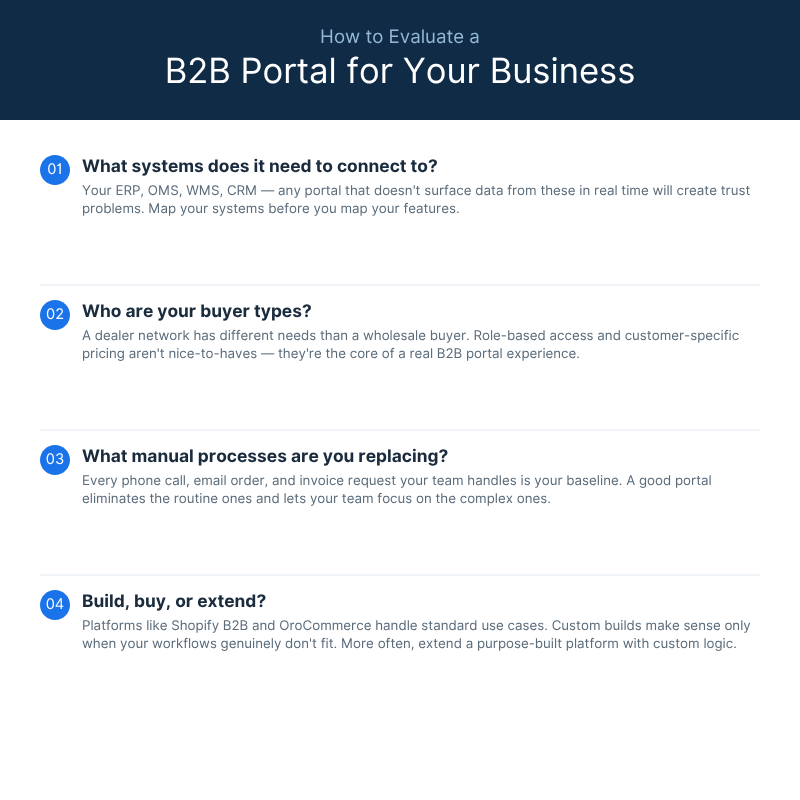
Looking at these B2B portal examples, a few questions consistently separate strong implementations from expensive failures:
What systems does it need to connect to? Your ERP, OMS, WMS, CRM — any portal that doesn’t surface data from these systems in real time will create trust problems downstream. Map your systems before you map your features.
Who are your buyer types, and what do they actually need? A dealer network has different requirements than a wholesale buyer portal. A distributor with a 50-person procurement team needs different access controls than a small regional reseller. Role-based access and customer-specific pricing aren’t nice-to-haves — they’re the core of a real B2B portal experience.
What manual processes are you replacing? Every phone call your CS team handles, every email order your team processes, every invoice request that goes through a rep — these are your baseline. A good B2B portal should eliminate the routine ones and let your team focus on the complex ones.
Build, buy, or extend? Platforms like Shopify B2B, OroCommerce, and Corevist have done most of the heavy lifting for standard use cases. Custom builds make sense when your workflows genuinely don’t fit a platform’s model — but that threshold is higher than most companies think. More often, the right approach is extending a purpose-built B2B platform with custom logic for your specific requirements.
Final Thoughts on B2B Portal Examples
A B2B portal isn’t a digital brochure with a checkout button. It’s the infrastructure that lets your dealers, distributors, and wholesale buyers do business with you the way they actually want to — on their schedule, without waiting on your team.
The B2B portal examples in this article weren’t built to chase a trend. They were built to solve real problems: CS teams underwater, order errors from disconnected data, distributors abandoning the channel because placing an order was too hard. The portal was the fix.
If your wholesale or dealer operation still runs on phone calls and email threads, the question isn’t whether you need a B2B portal. It’s how fast you can get one that actually works.