Must Have B2B Customer Portal Features – Checklist

Today, manufacturers and distributors aren’t asking whether they need a digital portal — they’re asking how to build a high-performing B2B self-service customer portal that truly delivers value. This guide breaks down everything you need to know about building a modern B2B customer portal, from strategic foundations to the must have B2B customer portal features that reduce customer effort, streamline operations, and drive measurable business impact.
The Shift Toward Digital-First B2B Buying
B2B buying behavior has fundamentally changed.
“How easy is it to work with you?” This has become a standard criterion for procurement teams when shortlisting vendors and suppliers. They expect speed, transparency, self-service, and real-time visibility.
The data reinforces this shift:
- 75% of B2B buyers prefer a sales experience without a representative.
- 66% of manufacturers are actively investing in customer portals.
This transformation is often referred to as the Amazon Effect. One-click ordering, instant tracking, and seamless returns reset the standard for what “good” looks like.
Research into customer loyalty has revealed something equally important: loyalty is not driven by delight. It is driven by reduced effort.
The greatest sin in modern commerce is wasting a customer’s time. Every unnecessary phone call, delayed quote, or manual invoice request adds friction, and friction erodes loyalty.
To meet these expectations, businesses are investing in modern B2B customer portals that empower buyers with the control, speed, and transparency they now demand.
Also read: Dealer E-commerce Portal For Better Channel Partner Relationships
What Is a B2B Customer Portal?
A B2B customer portal is a secure, private login-based digital environment where B2B customers can manage their entire relationship with a supplier in one place.
Unlike a basic e-commerce site that focuses only on transactions, a B2B customer portal functions as a self-service relationship hub. It gives buyers direct access to the tools, information, and workflows they need to operate efficiently, without relying on constant back-and-forth communication.
At its core, a modern B2B self-service portal allows customers to:
- Place and track orders
- Request and manage quotes
- Check real-time inventory and product availability
- Access negotiated pricing and contract-specific terms
- View invoices and make payments
- Download documentation and marketing collateral
- Generate reports and review order history
- Reach out directly to a dedicated sales representative when needed
This combination of self-service capabilities and structured communication tools gives buyers both independence and support, allowing them to complete routine tasks instantly while still maintaining a strong relationship with their account team.
How B2B Customer Portals Improve the Bottom Line
A well-designed B2B customer portal is not just a customer experience upgrade — it is a direct driver of operational and financial performance.
When implemented strategically, a B2B self-service portal improves the bottom line in several measurable ways:
Reduced Operational Costs
By shifting routine activities — order placement, invoice retrieval, shipment tracking, quote requests — to self-service, businesses reduce the administrative burden on sales and support teams. Fewer manual touchpoints mean lower labor costs and fewer processing errors.
Lower Dependency on Sales Representatives
Sales teams can focus on high-value activities such as relationship building, strategic accounts, and new business development instead of answering repetitive order-status emails or generating basic quotes.
Faster Ordering Cycles
When buyers can check inventory, view pricing, and place orders instantly, purchasing decisions accelerate. Shorter sales cycles directly increase revenue velocity.
Improved Customer Retention
Portals reduce friction. Reduced friction increases loyalty. When customers can manage their relationship seamlessly, they are far less likely to switch suppliers.
Repeat Purchase Acceleration
Features like one-click reorders, saved templates, and personalized catalogs make recurring purchases effortless — increasing order frequency and lifetime value.
Scalable Growth Without Proportional Labor
As transaction volume grows, a portal absorbs the operational load. Businesses can increase revenue without hiring proportionally more customer service staff.
Automation Benefits
Integrated workflows automatically update inventory, trigger invoicing, send notifications, and synchronize data across systems. Automation reduces errors and improves efficiency.
Integration Efficiency
By connecting directly to ERP, CRM, accounting, and logistics systems, a B2B portal eliminates duplicate data entry and ensures real-time accuracy — improving internal productivity and decision-making.
However, not all portals deliver these outcomes. The impact depends entirely on the features implemented.
Also read: How to turn your B2B portal into a High-converting sales machine?
B2B Customer Portal Essential Features
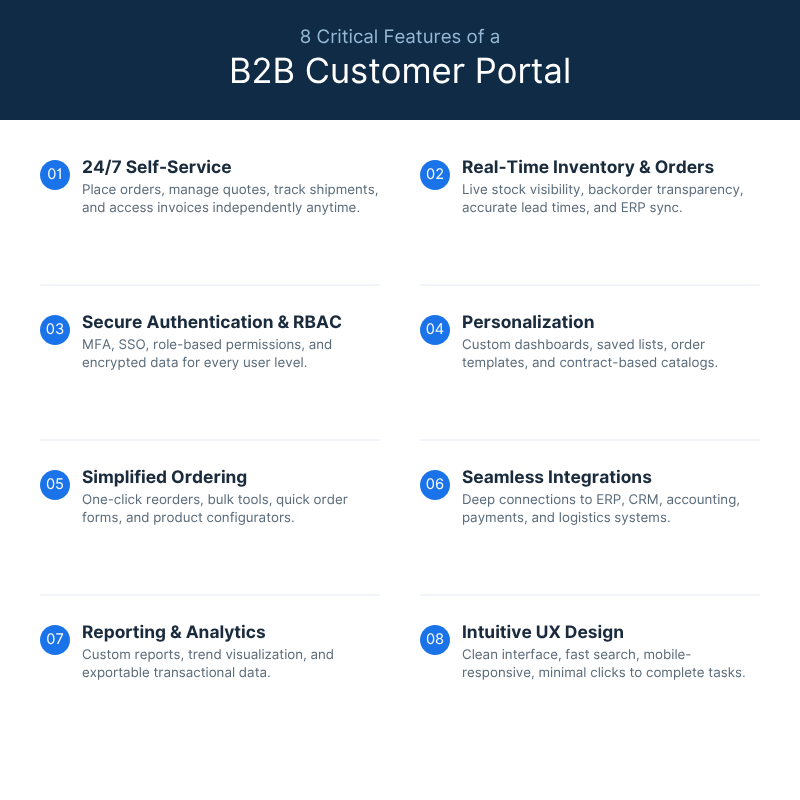
The best B2B customer portal designs and features go far beyond online ordering. They eliminate friction across the entire customer lifecycle — from product discovery to payment reconciliation — while integrating seamlessly with backend systems.
Below are the critical features of a B2B customer portal that directly impact customer effort, operational efficiency, and long-term growth.
24/7 Self-Service Functionality
At the core of every high-performing B2B self-service portal is comprehensive 24/7 access.
Buyers should be able to independently:
- Place and track orders
- Generate and manage quotes
- Check real-time inventory availability
- Access invoices
- Process payments
- Track shipments
- Submit service tickets
- Download technical documentation and marketing collateral
- Generate reports
- Reach out directly to their dedicated sales representative when needed
The goal isn’t to eliminate human relationships; it’s to remove unnecessary dependency. Customers should handle routine tasks while maintaining structured access to their account manager for strategic conversations.
Research consistently shows that loyalty is driven by reduced effort, not delight. When buyers can complete routine tasks without waiting on emails or callbacks, friction decreases — and loyalty increases.
Real-Time Inventory & Order Management
In B2B, especially manufacturing and distribution, visibility is critical.
Imagine a manufacturing client at 2 AM facing a production shutdown due to a missing component. Without real-time stock visibility, that delay becomes costly for both parties.
A modern portal should provide:
- Live stock availability
- Backorder transparency
- Accurate lead times
- Real-time order tracking
- Delivery notifications
- Document relationship maps (Quote → Order → Delivery → Invoice → Payment)
- Direct ERP synchronization
These core B2B portal features ensure customers can make informed decisions instantly — reducing risk and operational disruptions.
Secure Authentication & Role-Based Access
Security remains one of the most critical features of a B2B customer portal.
Given the sensitivity of pricing, financial data, and proprietary information, portals must include:
- Multi-factor authentication (MFA)
- Single sign-on (SSO)
- Role-based permissions (RBAC)
- Multi-user account access
- Private contract pricing visibility
- Data encryption
- Compliance readiness
Role-based access ensures procurement teams, finance departments, engineers, and executives each see only what they need — protecting data while improving workflow clarity.
Personalization & Customization
The best B2B customer portal designs and features create tailored experiences.
Key capabilities include:
- Personalized dashboards
- Drag-and-drop widgets
- Saved product lists
- Order templates
- Favorite products
- Contract-based product visibility
- Tailored product recommendations
Personalization reduces search time, simplifies repeat ordering, and strengthens long-term relationships.
Simplified & Accelerated Ordering
Speed directly impacts revenue.
A portal should include:
- One-click reordering
- Quick order forms
- Import order functionality
- Saved carts
- Bulk ordering tools
- Product configurators for complex SKUs
When repeat purchasing becomes frictionless, order frequency increases. Simplified ordering is a revenue accelerator.
Seamless System Integrations
A B2B customer portal must integrate deeply with backend systems.
Essential integrations include:
- ERP systems
- CRM platforms
- Accounting software
- Payment gateways
- Logistics tracking systems
- API connectivity
- Automated workflows
The portal sits on top of ERP infrastructure — it does not replace it. Instead, it unlocks ERP data and makes it accessible in a secure, customer-friendly interface.
These integrations eliminate duplicate data entry and reduce errors, forming the backbone of a comprehensive B2B portal features list.
Reporting & Analytics
Modern B2B buyers expect transparency.
A portal should allow customers to:
- Generate custom reports
- Track order volume
- Analyze lead times
- Export transactional data
- Visualize purchasing trends
- Integrate data into procurement systems
This empowers clients to make data-driven decisions while positioning your business as a strategic partner.
Intuitive, User-Friendly Design
Even the most powerful features fail without an intuitive interface.
A high-performing B2B customer portal must provide:
- Clean, uncluttered design
- Logical navigation
- Fast search functionality
- Mobile responsiveness
- Clear dashboards
- Minimal clicks to complete key tasks
B2B buyers do not have time to “learn” a portal. If it’s not intuitive, it won’t be used — and adoption determines ROI.
The best portals combine powerful backend functionality with effortless front-end usability.
Also read: Digital Ordering System for B2B: Why Portals Are Revenue Infrastructure
Ready to Build a High-Performance B2B Customer Portal?
If you’re evaluating how to implement a modern B2B customer portal, the conversation shouldn’t start with software — it should start with strategy.
Every organization has unique pricing structures, ERP environments, approval workflows, compliance requirements, and customer expectations. A high-performance portal must align with all of them — seamlessly.
Whether you’re modernizing legacy processes or building a new B2B self service portal from the ground up, the right architecture and integration approach will determine long-term success.
If you’re serious about reducing friction, accelerating ordering cycles, and scaling without operational bottlenecks, the next step is clarity.
Request a Portal Assessment – Evaluate your current workflows, systems, and customer experience gaps.
Let’s build it right. Schedule a call to discuss B2B portal development services.