Shopify Plus vs Salesforce Commerce Cloud
If you are considering Shopify Plus vs Salesforce Commerce Cloud and are unsure which platform best fits your business, this comparison breaks down where these two platforms differ most meaningfully.
Rather than listing every feature, this analysis focuses on the cost structure and core architectural and operational differences that typically drive decisions for mid-market and enterprise organizations.
We’ll start with pricing, then move into the major areas where Shopify Plus and Salesforce Commerce Cloud fundamentally diverge.
Shopify Plus Pricing vs Salesforce Commerce Cloud Cost
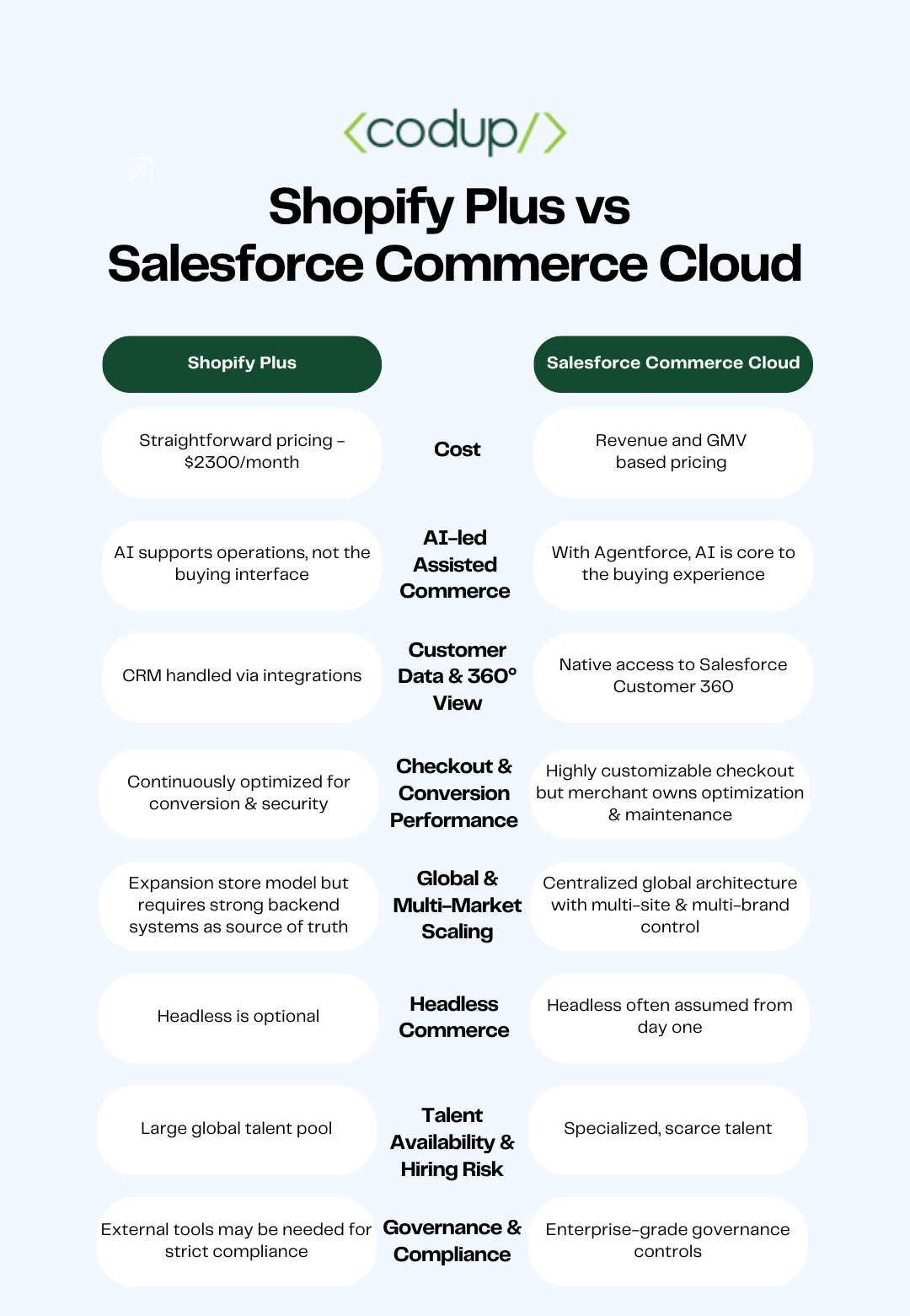
Shopify Plus follows a fixed, subscription-based pricing model. Pricing typically starts at a flat monthly fee (commonly cited around $2,300/month when paid annually), with predictable costs that are not directly tied to revenue growth. Hosting, infrastructure, security, performance optimization, and platform upgrades are included in the license fee.
Additional costs on Shopify Plus usually come from:
- Paid apps
- Custom development
- Middleware or integrations with ERP, PIM, CRM, or OMS systems
Salesforce Commerce Cloud uses a revenue-based pricing model, often tied to a percentage of Gross Merchandise Volume (GMV). While exact pricing varies by contract, costs increase as sales volume grows. In addition to platform fees, Salesforce Commerce Cloud implementations typically involve:
- Significant upfront implementation costs
- Ongoing development and customization expenses
- Dependence on certified Salesforce partners or in-house Salesforce expertise
As a result, Salesforce Commerce Cloud often carries a higher and less predictable long-term cost profile, particularly for fast-growing brands.
Major Differences in Shopify Plus vs Salesforce Commerce Cloud
Below are the core areas where the two platforms diverge, especially for enterprise and high-growth organizations.
Agentforce and AI-Led Assisted Commerce
Agentforce represents a fundamental philosophical difference between Salesforce Commerce Cloud and Shopify Plus.
Salesforce Commerce Cloud is increasingly built around agentic, AI-driven commerce experiences. With Agentforce, Salesforce positions AI assistants as active participants in the buying journey — not just recommendation engines, but conversational agents that guide discovery, answer questions, and even complete transactions.
Agentforce capabilities span both B2C and B2B use cases, including:
- Conversational product discovery using natural language, images, or videos
- Guided shopping and guided buying through chat and messaging interfaces
- AI-driven product recommendations grounded in enterprise data
- In-chat checkout using payment methods like Apple Pay and Google Pay
- AI agents that support merchandising workflows, promotions, and content creation
- Deep integration with Salesforce’s Customer 360 data across sales, service, and marketing
This approach is designed for organizations that believe AI-assisted, conversational commerce will become a primary interface, especially in environments where buying journeys are complex, consultative, or repeat-driven.
Shopify Plus takes a very different approach.
Rather than centering commerce around autonomous agents, Shopify Plus prioritizes high-performance, self-serve buying experiences. AI on Shopify is used primarily to:
- Improve operational efficiency (product content, admin workflows)
- Support merchant decision-making
- Enhance personalization and recommendations within the storefront
Conversational commerce, chat-based buying, and AI assistants on Shopify Plus are typically implemented through third-party apps or custom integrations, rather than being a core architectural pillar of the platform.
As a result:
- Salesforce Commerce Cloud appeals to enterprises investing heavily in AI-led, conversational, and sales-assisted commerce models
- Shopify Plus appeals to brands focused on speed, conversion efficiency, and scalable self-service experiences, where AI augments operations rather than driving the buying interface itself
This difference reflects a broader contrast between the two platforms: Salesforce Commerce Cloud optimizes for orchestration and assisted experiences, while Shopify Plus optimizes for frictionless execution at scale.
360° View of the Customer
One of Salesforce Commerce Cloud’s strongest differentiators is its native access to Salesforce’s broader ecosystem.
Salesforce Commerce Cloud enables:
- A unified customer profile across sales, service, marketing, and commerce
- Centralized customer data used across departments
- Advanced personalization driven by CRM and behavioral data
Shopify Plus maintains a strong customer data model at the commerce layer but does not attempt to act as a centralized CRM. Instead, it relies on integrations with external systems for deeper customer intelligence. This modular approach gives teams flexibility but requires deliberate data orchestration.
As a result:
- Salesforce Commerce Cloud is often chosen when a single, enterprise-wide customer view is a strategic requirement
- Shopify Plus is favored when teams want actionable commerce data without enforcing a monolithic data architecture
Conversion Performance and Checkout Philosophy
Checkout is a critical point of divergence between the two platforms.
Shopify Plus operates a locked-down, platform-managed checkout that is continuously optimized for performance, security, and conversion. Shopify invests heavily in checkout improvements at the platform level, resulting in consistently high conversion rates. Shopify Plus merchants frequently report materially higher conversion rates, with some citing figures up to 36% higher than those of Salesforce Commerce Cloud implementations.
Customization on Shopify Plus is handled through Checkout UI Extensions and Shopify Functions, allowing merchants to introduce business logic without compromising performance or PCI compliance.
Salesforce Commerce Cloud offers a more open and customizable checkout architecture. While this enables highly tailored checkout experiences, it also shifts responsibility for optimization, testing, and long-term maintenance to the merchant’s development team. Conversion performance is therefore more dependent on the quality of implementation and ongoing investment.
Globalization Capabilities
Both platforms support global commerce, but their approaches differ.
Salesforce Commerce Cloud is designed for highly centralized global operations, with strong support for:
- Multi-site and multi-brand architectures
- Shared or segmented catalogs
- Centralized control over pricing, promotions, and content
Shopify Plus supports international expansion through expansion stores, where each storefront operates as a separate instance. While this model requires stronger backend systems to act as a source of truth, it enables:
- Faster market launches
- Greater autonomy for regional teams
- Reduced operational overhead for each market
Salesforce Commerce Cloud tends to suit organizations with strict global governance, while Shopify Plus aligns better with brands scaling quickly across markets.
Headless Commerce Approach
Both Shopify Plus and Salesforce Commerce Cloud support headless commerce, but with different assumptions.
Shopify Plus treats headless as optional and incremental. Brands can start with a monolithic setup and selectively go headless for specific experiences—such as content-heavy pages, custom PDPs, or campaign microsites—without committing to a fully decoupled architecture.
Salesforce Commerce Cloud often assumes a headless or composable approach from the outset, particularly in complex enterprise environments. This provides maximum flexibility but requires greater engineering maturity and longer implementation timelines.
As a result:
- Shopify Plus is attractive to teams seeking flexibility without early complexity
- Salesforce Commerce Cloud fits organizations already operating within a composable enterprise ecosystem
Total Cost of Ownership (Beyond License Fees)
While platform pricing is important, the true cost difference emerges over time.
With Shopify Plus, ongoing costs often include:
- App subscriptions replacing native functionality
- Middleware for data synchronization
- Integration maintenance
However, Shopify Plus can reduce costs by:
- Lowering the ongoing development effort
- Minimizing infrastructure and performance management
- Making it easier to hire and scale teams due to platform familiarity
Salesforce Commerce Cloud may reduce reliance on third-party apps by offering deeper native enterprise functionality. At the same time, increased customization, longer release cycles, and higher dependency on specialized skills can result in higher long-term development and maintenance costs.
Talent Availability and Hiring Risk
Talent availability is an often-overlooked factor that has a meaningful impact on long-term platform sustainability.
Shopify Plus benefits from a large global talent pool. Developers, agencies, and internal teams with Shopify experience are widely available, onboarding is faster, and replacing vendors or team members carries lower risk. This makes it easier for organizations to scale teams, change partners, or bring work in-house over time.
Salesforce Commerce Cloud requires more specialized expertise, often tied closely to the broader Salesforce ecosystem. Skilled Commerce Cloud developers are in short supply, and organizations often rely on certified partners for both implementation and ongoing development. This can increase dependency on specific vendors and lead to higher long-term resourcing costs.
In practice:
- Shopify Plus reduces hiring friction and vendor lock-in
- Salesforce Commerce Cloud trades talent flexibility for deeper enterprise specialization
Governance, Compliance, and Enterprise Controls
Governance requirements vary widely across organizations, and this is another area where the platforms diverge.
Salesforce Commerce Cloud is often favored by enterprises with strict governance, compliance, and audit requirements. Its tight integration with Salesforce’s broader platform allows for consistent role-based access, approval workflows, and enterprise-wide policy enforcement across commerce, sales, and service.
Shopify Plus takes a more opinionated and streamlined approach. Governance controls exist, but they are intentionally simplified, prioritizing speed and operational efficiency over granular internal policy enforcement. For many organizations, this reduces friction; for others, particularly in heavily regulated environments, it may require supplemental controls through external systems.
As a result:
- Salesforce Commerce Cloud aligns well with compliance-heavy or process-driven enterprises
- Shopify Plus aligns better with organizations optimizing for execution speed and autonomy
Ecosystem Lock-In vs Best-of-Breed Flexibility
A final strategic difference lies in how each platform approaches ecosystem dependency.
Salesforce Commerce Cloud is most effective when implemented as part of the broader Salesforce Customer 360 ecosystem. When sales, service, marketing, and commerce all operate within Salesforce, data flows naturally and orchestration is powerful. However, partial adoption can be costly, and moving away from the ecosystem later often involves significant switching effort.
Shopify Plus is designed to support a best-of-breed technology stack. Merchants can pair Shopify with the tools that best fit their needs, such as ERP, CRM, OMS, CMS, personalization, or analytics, without being tightly coupled to a single vendor ecosystem. This flexibility reduces long-term lock-in, but it requires a stronger architectural discipline to keep systems aligned.
In strategic terms:
- Salesforce Commerce Cloud favors deep ecosystem commitment
- Shopify Plus favors modular flexibility and optionality
Final Verdict: Shopify Plus vs Salesforce Commerce Cloud
The choice between Shopify Plus and Salesforce Commerce Cloud is not about which platform is more capable; it’s about which operating model aligns with your business.
Shopify Plus excels at conversion optimization, speed to market, predictable costs, and operational efficiency. It is particularly well-suited for brands prioritizing growth, experimentation, and self-serve commerce, with backend systems acting as the system of record.
Salesforce Commerce Cloud is built for enterprise orchestration, sales-assisted workflows, and unified customer data. It shines in organizations where commerce is deeply intertwined with sales, service, and CRM, and where long implementation cycles and higher TCO are acceptable trade-offs for centralized control.
Ultimately, the decision reflects whether your business values speed and simplicity or depth and orchestration, and which constraints you are prepared to manage as you scale.
Click here for free eCommerce consultation.