Digital Maturity Assessment for Manufacturers: How Ready Are You to Digitize the Complex Sale?

A structured digital maturity assessment is essential to give manufacturing leaders a practical, honest way to baseline where they stand today in real operational capabilities and what the future roadmap should look like for complete digital transformation.
By understanding your maturity across the pillars of people, process, platform, and data, you can create a roadmap that is realistic, achievable, and aligned with your business needs.
What is Digital Maturity?
Digital maturity is the gap between where your organization is today and what it will take to operate efficiently in a data-driven, customer-centric world. And that gap is almost never about technology alone. It’s shaped by your people, your processes, your product content, your workflows, and how well your systems and data are aligned.
Why Do You Need a Digital Maturity Assessment?
Not all digital transformation initiatives succeed. We’ve all heard stories of manufacturers spending millions on digital platforms, portals, or eCommerce builds—only to discover months later that neither their customers nor their internal teams want to use the shiny new tools they invested in.
Before any digital transformation, a business needs to adopt the right mindset, align its processes, clean up its data, and do the foundational work that allows technology to succeed. This is the essence of digital maturity.
When these foundations are weak, two major risks appear:
- Low adoption rates — teams, reps, distributors, and contractors won’t use tools that don’t fit their real workflows.
- Misaligned digital solutions — organizations end up building tools that simply replicate broken processes or fail to match how work actually gets done.
Before investing in eCommerce, portals, CPQ, integrations, or automation, the most important step is knowing whether your foundation can support the scale you want. This is where a digital maturity assessment becomes invaluable—the lens through which you avoid costly mistakes and ensure your digital initiatives deliver true value.
This digital maturity assessment is a structured way to measure whether your people, processes, platforms, and data are ready to support the digital experiences your customers now expect.

The B2B Digital Maturity Assessment for Manufacturers
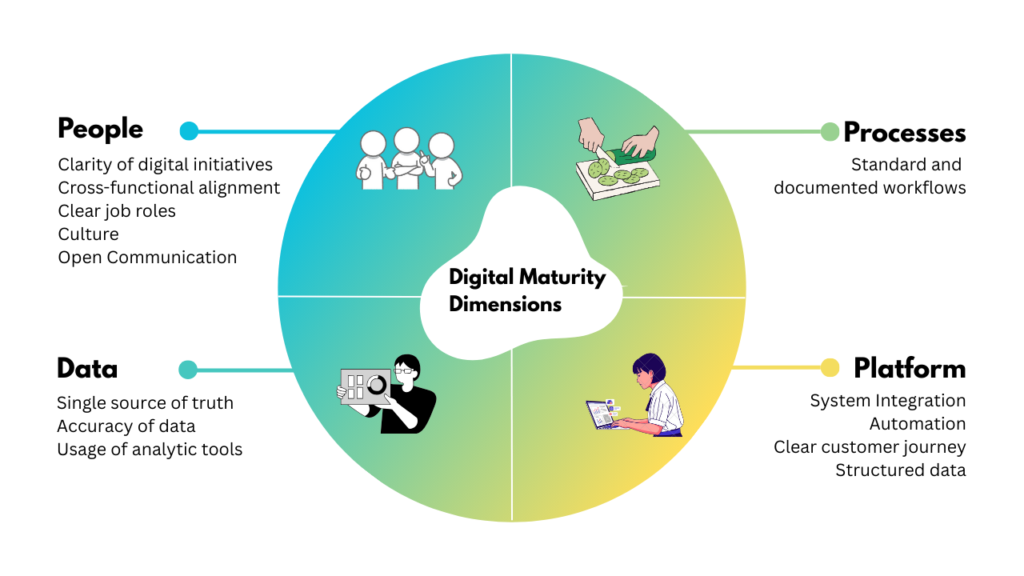
The most reliable way to evaluate readiness is through four interconnected pillars: People, Process, Platform, and Data. Each pillar represents a practical requirement for modernizing product content, strengthening channel relationships, improving customer experience, and scaling digital commerce.
Below is a clear and engaging breakdown of the four pillars.
Pillar 1: People
Digital maturity assessment always begins with people. Technology succeeds only when the humans behind it are aligned, supported, and capable. This pillar evaluates the real-world factors that either accelerate transformation or quietly derail it behind the scenes.
It examines how deeply teams understand digital priorities, how effectively leadership drives alignment, and whether the organization has the mindset and skills to support sustainable change.
Key indicators of People’s maturity include:
• Clarity of digital strategy. Do teams understand the purpose behind the initiative, or only the tasks assigned to them
• Cross-functional alignment. Are sales, marketing, product, IT, operations, and customer service moving toward shared goals
• Defined roles and ownership. Are responsibilities clear or spread informally across overloaded teams
• Skills and training. Do teams have the knowledge and tools needed to adopt new systems and workflows
• Culture of experimentation. Can teams test ideas, run pilots, and contribute honest feedback
• Open communication. Are decisions shared clearly or made inside isolated departments
No PIM, DAM, portal, configurator, or integration initiative survives without organizational readiness. The People pillar is the foundation. Without alignment and ownership, even the best technology performs like a starship without a crew. Impressive on paper, but ineffective in flight.
Pillar 2: Processes
If the People pillar represents readiness, the Process pillar represents execution. A digital maturity assessment looks beyond tools and examines whether underlying workflows are structured enough to support them. Many digital projects fail not because the platform was lacking, but because the processes feeding it were inconsistent or built around tribal knowledge.
This pillar draws on Operations, Customer Experience, and User Experience domains to understand how work actually gets done inside your organization.
Key indicators of Process maturity include:
- Documented and standardized workflows
- Structured collection of customer interactions and feedback
- User experiences optimized for real-world tasks, such as building submittals or finding compatible variants
- Governance models that prioritize decisions based on customer impact and business metrics
- Cross-department coordination to ensure consistency across teams
In manufacturing, frictionless processes are the backbone of scalable digital transformation. When workflows are manual, inconsistent, or disconnected, even advanced tools become slow and frustrating. Strong process maturity reduces delays, eliminates rework, and fosters familiar and predictable interactions across every channel.
Pillar 3: Platform
The Platform pillar evaluates the strength and reliability of the digital ecosystem that powers your operations.
In a digital maturity assessment, it measures how well your systems connect, how clean your product data is, and how consistently information flows across every internal and external channel.
Key indicators of Platform maturity include:
• System integration and automation between ERP, CRM, PIM, commerce, portals, and apps
• Accuracy and structure of product data, including attributes, certifications, and variant logic
• Consistency and version control of digital assets such as spec sheets, images, and installation materials
• Marketing technology alignment with automation, segmentation, and analytics
• Unified customer journey data across tools and platforms
In the manufacturing world, product data is the engine that drives search, selection, compatibility, and ordering. If the platform is not mature, the engine sputters. A strong Platform score indicates that your digital foundation can support CPQ, automated submittals, rep portals, AI-powered recommendations, and future integrations without friction.
Pillar 4: Data
If the Platform pillar describes how systems connect, Data describes the quality of what flows through them. Data maturity determines whether product, customer, and operational information is accurate, structured, and governed well enough to support modern workflows.
Key indicators of Data maturity include:
• Clean, consistent, and standardized product and customer data
• Reliable pricing, compatibility rules, and attribute structures
• A single source of truth instead of scattered spreadsheets
• Teams that rely on dashboards and analytics tools rather than intuition
• Governed data entry, validation, and updates across departments
Data maturity determines the accuracy of every digital experience. When data is clean and governed, quoting becomes faster, configurators become smarter, portals become more useful, and customer interactions become far more consistent.
When data is weak, every digital tool becomes unpredictable. It is like feeding a navigation system incorrect coordinates. The interface might look sleek, but the results will send you off course.
Final Thoughts
Digital transformation is not about buying platforms; it’s about embracing them. It is about preparing the foundation that allows platforms to succeed. A digital maturity assessment provides manufacturers with the clarity to understand their current state, identify areas for improvement, and determine which investments will yield the greatest impact.
Tools succeed only when people, processes, platforms, and data are ready to support them. With strong digital maturity, every part of your digital ecosystem becomes faster, cleaner, easier to use, and more scalable.
Click here to book a consultation with our B2B eCommerce and digital transformation consultants.