Shopify Plus vs BigCommerce Enterprise: Choosing the Right Platform for Scale
If you are considering Shopify Plus vs. BigCommerce Enterprise and are unsure which one best suits your needs, this detailed analysis will break down their major differences and how they compare to each other.
We’ll examine the cost comparison and then discuss the main features where they differ.
Shopify Plus Pricing vs BigCommerce Enterprise Cost
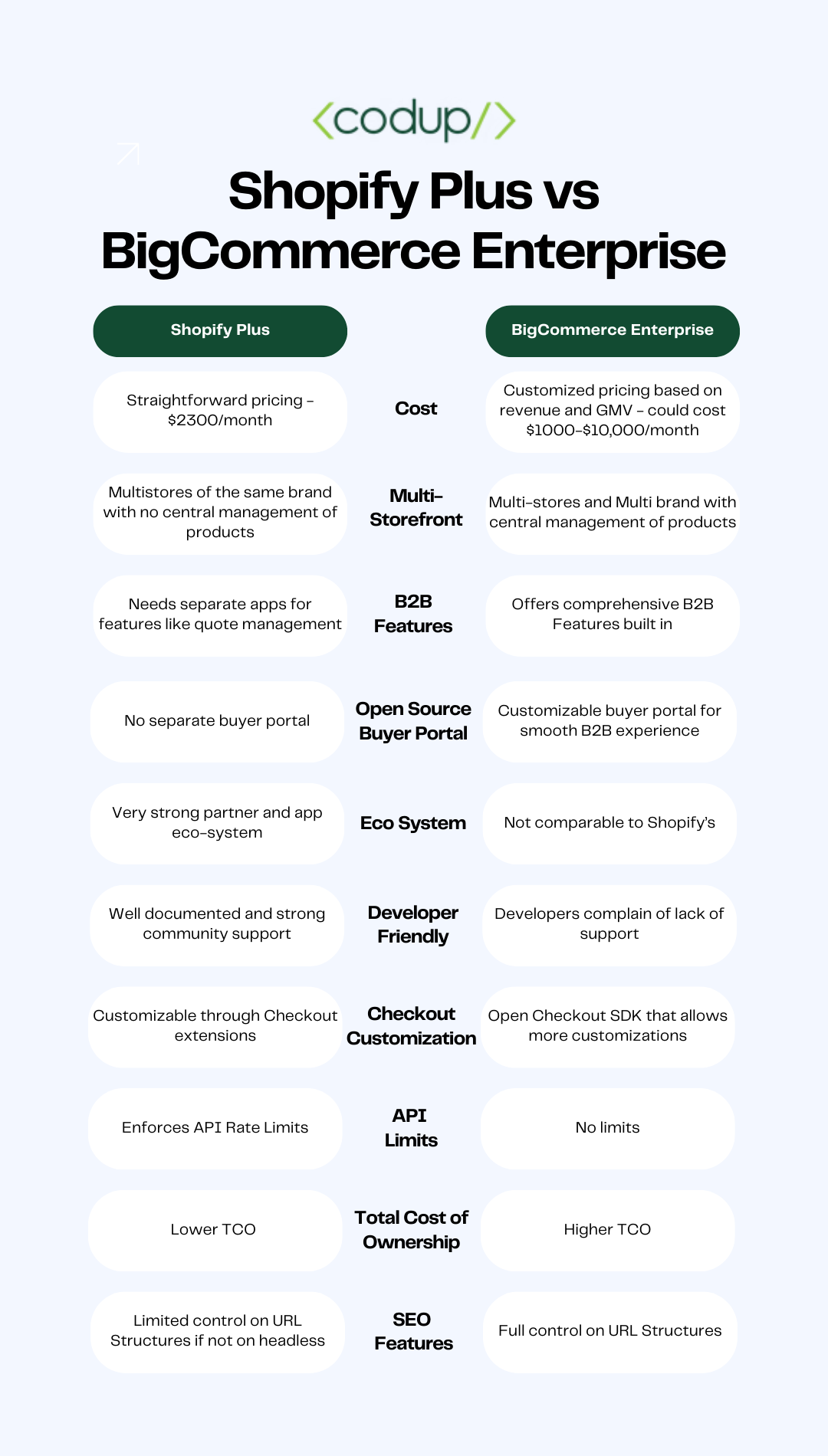
Shopify Plus follows a more standardized pricing model. It typically starts at a fixed base fee of around $ 2,300 per month, paid annually. It includes 9 expansion stores, with a cost of $250 per additional store.
BigCommerce Enterprise, on the other hand, uses a more customized pricing approach based on factors like annual revenue, catalog size, and complexity, and the price could range from $1000-$10,000/month.
Major Differences in Shopify Plus vs BigCommerce Enterprise
Below are the core areas where the two platforms meaningfully diverge, especially for mid-market and enterprise merchants.
Multi-Storefront
BigCommerce Enterprise offers native multi-storefront capabilities from a single backend. This allows businesses to run multiple storefronts—by brand, region, language, or customer segment – while managing products, pricing, and settings centrally. Storefronts can share catalogs or diverge where needed, without duplicating infrastructure.
Shopify Plus supports multiple storefronts through expansion stores, but each storefront is a separate instance of a store. Products, configurations, and settings are not centrally managed by default. As a result, businesses typically rely on a central source of truth—such as an ERP or PIM system—to manage product, pricing, and inventory data. Synchronization is handled through integrations, apps, or custom middleware, keeping all stores aligned.
B2B Features
BigCommerce Enterprise is often described as B2B-first. It includes native support for:
- Customer groups and tiered pricing
- Bulk ordering and quick order forms
- Quote management and purchase orders
- Invoice-based workflows
- Sales rep impersonation (masquerading)
Shopify Plus has made significant progress with Shopify B2B, introducing company profiles, catalogs, and payment terms. However, more advanced workflows – such as quoting, complex permissions, and sales rep tooling – typically require apps or custom development.
Open-Source Buyer Portal and Advanced User Roles
This is one of the clearest points of differentiation.
BigCommerce Enterprise supports open and extensible buyer portals that can be customized using APIs. This enables:
- Custom user roles and permissions
- Quick order and bulk order tools
- Sales staff quoting
- Sales masquerading (ordering on behalf of customers)
- Fully custom front-end B2B portals
Shopify Plus enables you to customize customer accounts using customer account UI extensions and the Customer Account API. However, there are limitations to achieving a company hierarchy structure within the native customer account in Shopify Plus.
Partner and App Ecosystem
One of the strongest advantages of Shopify Plus is the depth and maturity of its partner and app ecosystem. Shopify Plus merchants have access to thousands of apps that cover nearly every common commerce use case, including subscriptions, loyalty, reviews, promotions, analytics, personalization, internationalization, and more. For many businesses, this means functionality can be added quickly without custom development, allowing teams to move faster and test new ideas with lower upfront investment.
In addition to apps, Shopify Plus benefits from a large global partner network. There is a wide pool of experienced agencies, developers, and solution partners who specialize in Shopify Plus, making it easier to find implementation support, ongoing optimization, and internal talent.
Developer-Friendly Platform
Shopify Plus is widely considered more developer-friendly, not because it is the most open platform, but because it is well-documented, consistent, and predictable.
Shopify provides:
- Extensive and well-maintained API documentation
- Clear versioning and upgrade paths
- A mature developer experience with SDKs, CLIs, and testing tools
- Shopify Functions and Checkout UI Extensions for safe, scalable customization
This strong documentation and tooling are a major reason Shopify has become so popular among developers. Teams can onboard faster, build with confidence, and spend less time reverse-engineering platform behavior. The clear guardrails reduce ambiguity and make long-term maintenance easier, especially as teams and systems scale.
BigCommerce Enterprise offers powerful APIs and a more open architecture, but its developer documentation and ecosystem maturity lag behind Shopify’s. While experienced teams can build highly customized solutions, developers often face steeper learning curves and less community-driven support, which can slow development and increase reliance on specialized knowledge.
Checkout, Payments, and Conversion Rate
Checkout is one of the most critical areas where Shopify Plus and BigCommerce Enterprise take fundamentally different approaches.
Shopify Plus operates a locked-down, highly optimized checkout that is continuously improved at the platform level. It is designed to handle extreme traffic spikes, global payment methods, and mobile-first conversion optimization, all without requiring merchants to manage performance or security concerns. Customization is handled through Checkout UI Extensions and Shopify Functions, which enable businesses to introduce custom logic—such as discounts, free gifts, messaging, and validation—without compromising PCI compliance or stability.
BigCommerce Enterprise offers a more open checkout architecture, allowing deeper customization and control over the checkout experience. While this flexibility can be valuable for highly bespoke workflows, it also shifts more responsibility to the merchant’s development team for performance, testing, and long-term maintenance.
API Limits
API behavior is a critical consideration for enterprise merchants integrating ERP, PIM, CRM, OMS, and middleware layers.
Shopify Plus enforces API rate limits, which apply at all levels, including the enterprise level. However, these limits are predictable and can be efficiently managed using GraphQL, batching, and event-driven architectures. Shopify’s APIs are well-documented and widely adopted, which reduces integration risk and accelerates development.
BigCommerce Enterprise is often favored for its more permissive API usage, with fewer practical limits on API calls. This can be advantageous for real-time integrations, complex synchronization scenarios, or highly customized backend workflows.
Total Cost of Ownership (Beyond License Fees)
While upfront pricing is important, the true cost difference between Shopify Plus and BigCommerce Enterprise emerges over time.
With Shopify Plus, additional costs often come from:
- Paid apps replacing native functionality
- Middleware to synchronize data across multiple stores
- Ongoing integration maintenance
However, Shopify Plus can reduce costs in other areas by:
- Lowering development effort for common use cases
- Reducing operational risk through platform-managed infrastructure
- Making it easier to hire and scale teams
BigCommerce Enterprise may reduce dependency on third-party apps due to its stronger native feature set, particularly for B2B and multi-store use cases. At the same time, increased customization and ownership of complex workflows can result in higher long-term development and maintenance costs.
SEO and Content Control
SEO and content flexibility are another area where platform philosophy plays a role.
BigCommerce Enterprise offers greater native control over elements such as URL structures, robots.txt files, and advanced indexing behavior. This can be beneficial for content-heavy, international, or SEO-driven businesses that require granular control.
Shopify Plus takes a more opinionated approach to SEO, prioritizing consistency and performance over customization. While this limits certain structural changes, it also reduces the risk of misconfiguration and ensures platform-level optimization remains intact.
Final Verdict: Shopify Plus vs BigCommerce Enterprise
The choice between Shopify Plus and BigCommerce Enterprise is not about which platform is more powerful—it’s about which constraints your business is trying to solve today and which ones you’re willing to manage tomorrow.
Shopify Plus excels at speed, ecosystem leverage, and operational simplicity. Its mature app marketplace, well-documented APIs, reliable checkout, and large global partner network make it an excellent fit for businesses that prioritize rapid execution, marketing-led growth, and ease of scaling teams. For organizations with robust backend systems (ERP, PIM, CRM) serving as a central source of truth, Shopify Plus offers a stable and efficient commerce layer on top.
BigCommerce Enterprise, by contrast, is built for control, flexibility, and native complexity. Its centralized multi-storefront capabilities, product overrides, and deep out-of-the-box B2B features reduce the need for third-party apps and custom middleware. For manufacturers, wholesalers, and distributors with complex catalogs, account hierarchies, and sales-assisted workflows, BigCommerce can simplify operations by handling more of this complexity within the platform itself.
Schedule free eCommerce consultation with our experts at Codup.