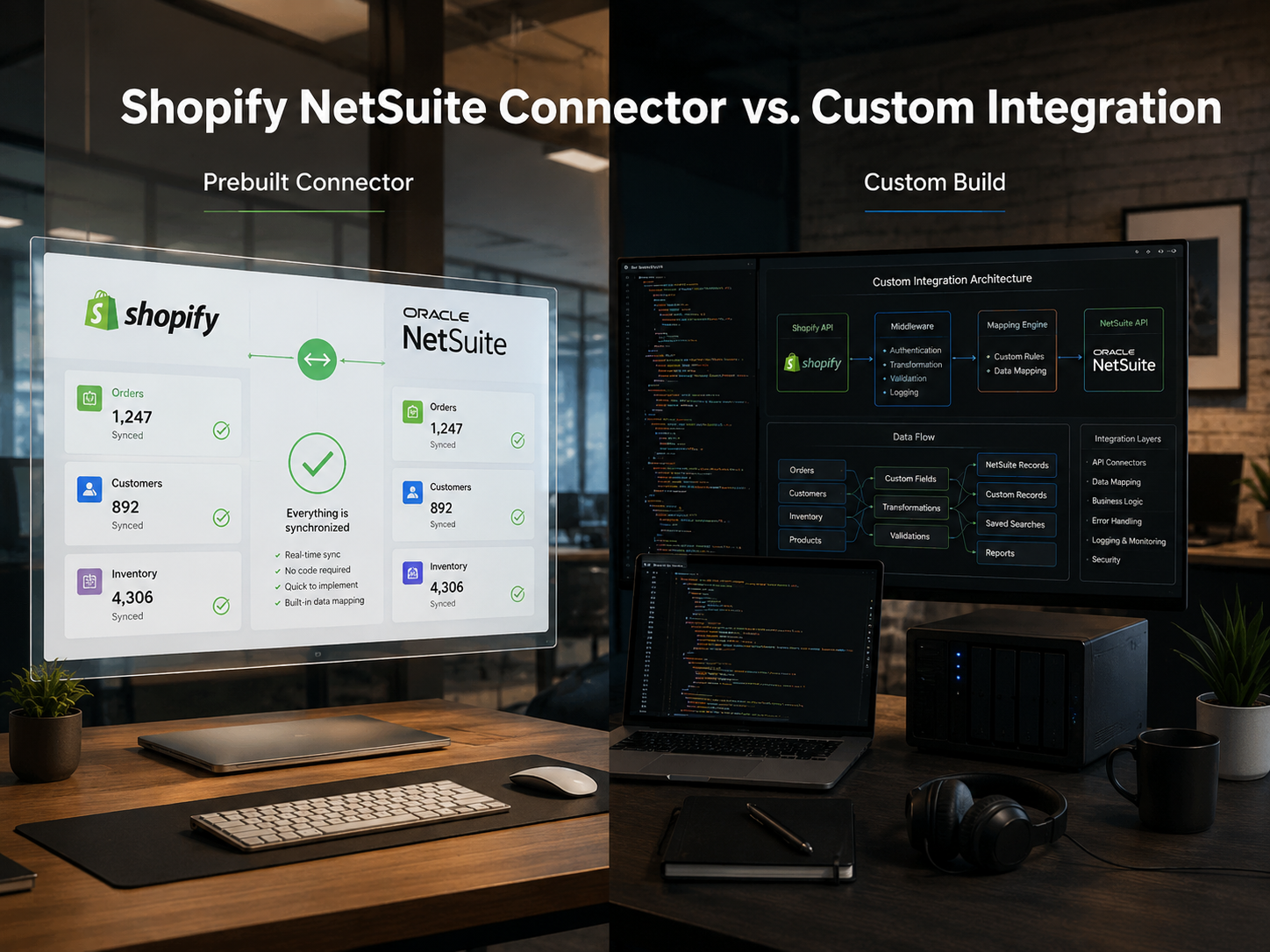
Is Headless Shopify Worth It and When It Makes Sense

This article is here to answer one very practical question: “Is headless Shopify worth it? And am I at the stage when headless Shopify makes sense — or am I about to pay for over-engineering?”
Headless Shopify gets talked about like it’s the next level up from “normal” Shopify – as if serious brands eventually graduate to it.
They don’t.
Headless isn’t an upgrade path. It’s an architecture choice.
And like any architecture choice, it only works when you’ve hit specific constraints and have the team, budget, and roadmap to make that complexity pay for itself.
What is “Headless Shopify”
Headless commerce is simple in theory: the frontend of your store is separated from the backend.
Instead of Shopify rendering your pages through Liquid templates, a custom frontend application communicates with Shopify entirely through APIs.
With headless Shopify, you use Shopify for managing products, orders, payments and everything related to eCommerce operations but you use a different technology like Hydrogen or custom React to create the user experience for your customers.
Everything your customers see is controlled by your custom frontend.
Everything that makes the commerce work still lives inside Shopify.
Both the layers are connected through Shopify APIs.
Also read: Why Modern Leaders Are Moving Toward API-Based Digital Commerce
A headless storefront using Shopify can be created using any technology. Next JS, React, Vercel, etc are all popular choices for the custom frontend.
However, Shopify has its own headless framework which makes it easier to set up headless applications. Let’s look at the official Shopify headless stack:
Hydrogen (React + Remix)
Oxygen Hosting (Included with Shopify Plus)
How Hydrogen Differs from Rolling Your Own React/Next.js
| Hydrogen | Custom React/Next.js | |
| Shopify API integration | Built-in, optimized | You build everything |
| Cart & product components | Included | Build from scratch |
| Caching | Commerce-aware defaults | DIY caching strategy |
| Hosting | Oxygen included | Vercel/Netlify/Custom infra |
| Developer velocity | Faster for eCommerce | More flexible, more work |
Hydrogen accelerates typical eCommerce patterns. It’s usually the recommended technology if you’re building anything for web commerce.
On the other hand, if you are building cross platform, hybrid apps that would work on all devices like mobile, custom React might make more sense.
It also depends on the kind of expertise you have in house. Hydrogen is actually a newer and more niche technology and finding developers with expertise in Hydrogen is more difficult than finding React or NextJS experts.
The Headless Ecosystem Around Shopify
When you go headless, it means you lose access to the app eco system of Shopify. This means you’ll need to build a composable stack that includes best of breed technologies for different services you would need. Here are some technologies you would need to include in your stack apart from the frontend:
- Frontend Framework Options (Hydrogen, NextJS, etc)
- CMS (Sanity, Storyblok, etc)
- Search: Typesense, Algolia
- Promotions: Custom logic or microservices
- Reviews: Custom API integration
- Loyalty: API-based widgets
- Personalization engines
- Video/CDN management
- Email & marketing stack integration
A headless Shopify store typically becomes a network of services, all talking to each other through APIs.
Having said that, let’s talk about is Shopify headless worth it.
Time to bust some myths and misconceptions around this.
Is Shopify Headless Good for Speed?
Experts often use performance as a common argument to the question ‘is Shopify headless worth it’.
Brands often hear that a decoupled frontend, built with React, Next.js, or Hydrogen will automatically be faster than a traditional Liquid theme. But the data tells a very different story.
Shopify’s own performance analysis shows that roughly 59.5% of Liquid stores passed all Core Web Vitals as of September 2023, a number that continues to rise as Online Store 2.0 evolves.
Surprisingly, Liquid consistently outperforms most server-side rendered (SSR) headless frameworks, even those built on modern React tooling.
And when Google replaced First Input Delay (FID) with Interaction to Next Paint (INP) in 2024, the gap became even more obvious.
In many cases, poorly engineered headless builds were slower than well-optimized Liquid themes.
More often than not, speed issues stem from bloated themes, unoptimized images, or dozens of heavy apps, not from Shopify itself.
Chasing a headless rebuild to fix these foundational issues becomes a very expensive way to solve the wrong problem.
In many cases, the push for headless performance is more about Lighthouse scores and vanity metrics than actual revenue impact.
That doesn’t mean performance is never a valid reason to go headless.
If you need custom caching strategies across regions, edge rendering for global markets, or extremely dynamic experiences at scale, then a headless setup can deliver real, measurable gains.
But at Codup, we advise our clients to exhaust the high-leverage fixes first. Clean up the theme. Optimize images. Remove heavy apps. Improve hosting and caching. These improvements often get you 80–90% of the speed benefits, with a fraction of the cost and complexity of going headless.
Is Headless Shopify Better for SEO?
Headless Shopify doesn’t automatically improve SEO — but it can unlock several technical advantages that are harder or impossible to achieve with native Shopify themes. A headless build won’t magically boost rankings on its own, but the flexibility, control, and performance engineering that come with a decoupled frontend can create the conditions for stronger organic visibility.
The real SEO advantages come indirectly, through better implementation of technical best practices.
1. Better Control Over URL Structures
Headless Shopify allows you to fully customize URLs instead of being limited by Shopify’s native patterns.
For content-heavy brands, this means cleaner architecture, stronger topical silos, more intentional content hubs, and better internal linking — all of which can contribute to SEO performance.
2. Superior Performance Potential
Modern frameworks like Next.js, Remix, and Hydrogen offer techniques such as hybrid rendering, code splitting, edge deployment, and aggressive bundling.
When executed well, the result is significantly faster page loads and improved Core Web Vitals — which can influence both rankings and user engagement metrics (NavBoost).
3. Built-In Asset & Image Optimization
Frameworks like Next.js ship with image optimization tooling by default. Images are resized, compressed, cached, and delivered efficiently — often outperforming native Shopify in asset delivery.
These optimizations directly improve speed and UX.
4. Programmatic SEO Opportunities
Headless storefronts are data-first. They naturally lend themselves to large-scale, structured page generation during the build process.
You can map over product data, locations, dealers, variants, and metafields to produce hundreds or thousands of targeted pages—ideal for long-tail SEO strategies.
5. Scalability for Large Catalogs
Because headless storefronts lean on APIs and programmatic routing, they scale easily as your catalog or content footprint grows — without bloating your theme.
6. Easier Meta Tags & Schema at Scale
With control over the frontend code, you can generate schema, meta tags, and structured data programmatically across all page types — a major advantage for SEO consistency.
7. Better Crawl Budget Management
Native Shopify creates multiple duplicate URL paths for products and collections (even if canonicalized).
Headless lets you define clean, single-source routes programmatically — reducing crawl waste and ensuring search engines focus their attention on the pages that matter.
When Headless Shopify Is Not Worth It
This is the part most agencies avoid saying out loud, but it needs to be said: a lot of brands go headless for the wrong reasons. Not because they actually need the architecture but because they’re chasing a trend, a metric, or a misconception.
So let’s be brutally honest and walk through the motivations that sound valid but fall apart under scrutiny.
You Want a Faster Site
Speed is important, but going headless just to make the site faster is almost always a misdiagnosis.
Most Shopify performance issues come from things that have nothing to do with Liquid: heavy third-party apps that block rendering, bloated themes built over years of patchwork edits, unoptimized images, and a complete lack of caching strategy. Fixing these problems usually yields dramatic speed gains without ripping out your entire frontend and replacing it with a custom React application.
And in practice, a well-engineered Liquid build routinely outperforms a mediocre headless build.
If speed is the only complaint, headless is a very expensive way to avoid cleaning up what actually needs fixing.
You Want More Design Freedom
Headless will absolutely give you more design freedom but most brands don’t realize how much flexibility Shopify’s modern themes already offer.
With Online Store 2.0, you can add sections anywhere, build dynamic layouts, use metafields to power custom content, and extend pages with app blocks or custom Liquid components.
That covers 90% of the design ambitions most brands have.
Everyone Is Going Headless
This is one of the most dangerous traps. It’s easy to see Allbirds, ILIA Beauty, or the latest luxury brand launching a flashy headless storefront and assume that’s the standard to emulate. But those brands are not typical.
They have entire engineering teams, direct Shopify support, enormous budgets, and complex operational needs.
Their constraints justify headless; they’re not chasing it for aesthetics.
Copying their architecture without their scale or resources is a guaranteed way to burn money and end up with a system your team struggles to maintain.
Your brand’s needs—not industry hype—should dictate the architecture.
You Want a Custom Checkout
This is a persistent myth. Going headless does not give you a fully custom checkout. Shopify’s checkout, especially on Plus, is still the required path for orders.
You can extend it, style it, customize it with Checkout Extensibility, and add logic, but you cannot replace it.
Headless doesn’t change Shopify’s rules around payments, fraud checks, or PCI compliance.
If you’re considering headless because you believe it unlocks a custom checkout, you’ll end up disappointed and no closer to your goal.
A perfect real-world example is Wild Fork Foods, a fast-growing DTC meat retailer in the U.S. Their entire business model depends on variable-weight pricing in which the final price of an order is calculated at fulfillment based on the exact weight of each product.
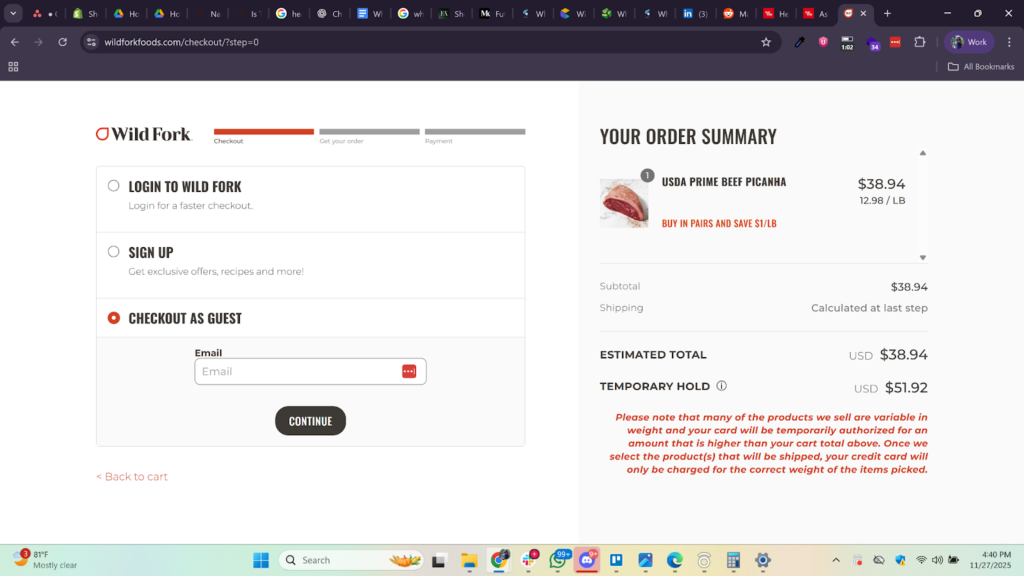
This means the checkout price must be dynamic, recalculated in real time, and adjusted based on weight captured at the warehouse.
Shopify simply cannot support this pricing model, whether you’re using Liquid, Hydrogen, Next.js, or any headless architecture. The limitation isn’t the frontend, it’s Shopify’s backend pricing engine.
Wild Fork understood this and migrated to CommerceTools, a fully API-first composable platform where pricing, carts, and checkout logic can be completely custom-coded.
You Want to Future-Proof Our Architecture
“Future-proofing” sounds strategic, but in reality it often means paying for complexity you don’t need.
Headless introduces new workflows, new costs, new dependencies, and new risks.
If your current setup works well and your team isn’t hitting hard limits, you’re not future-proofing by going headless, you’re simply moving ahead of your own needs.
You can always transition to headless once you hit real constraints. Until then, it’s wiser to optimize what you have, not rebuild it for hypothetical scenarios.
Benefits of Headless Shopify and Is Shopify Headless Worth It
Headless Shopify delivers incredible value but only when it’s a response to real constraints, not a desire to follow industry trends. The brands that get the most out of headless aren’t trying to be modern for the sake of it. They’ve simply reached a stage where Shopify’s theme layer can’t keep up with their content demands, UX ambitions, global footprint, or internal workflows.
Below are the real case scenarios where headless is not only justified, but where it creates clear, measurable ROI, supported by real-world examples.
So, is Shopify headless worth it? Yes, it is worth it when…
When You’re a Content-Heavy, CMS-First Marketing Engine
Some brands outgrow Shopify’s native content tools long before they outgrow its commerce capabilities. If your business relies heavily on editorial storytelling, educational content, or multi-language publishing, the theme editor becomes a bottleneck fast.
Shopify themes struggle with:
- Limited content modeling
- Basic approval workflows
- No true revision history
- Difficulty managing multi-region or multi-brand content
- Fragmented content creation across teams
For brands like these, headless Shopify makes sense.
Case Study:
For example, a luxury jewelry brand moved to a headless architecture using Shopify Plus + Sanity CMS + Next.js. The shift completely transformed their content operations. Editors could finally manage multi-language storytelling, landing pages, and campaign content from a centralized CMS instead of fighting the constraints of Shopify’s admin.
If your brand feels more like a publisher than a storefront, Shopify headless makes sense — especially with CMSs like Sanity, Storyblok, Builder.io, or Contentful.
However, if content management is all you need, you can consider a hybrid approach where you use native liquid theme but integrate Shopify with a CMS like Sanity.
When You Need Single Page Applications Integrated with Shopify’s Backend
Think about advanced product configurators, guided selling quizzes, and 3D/AR experiences.
In most cases, it’s easier to build out these features in React with its global components rather than stitching together something in Liquid and vanilla JS.
But again, going completely headless and rooting out all your PDPs and collection pages to move to headless isn’t necessary at all.
What makes the most sense here is to build a single page application using Shopify headless. A good example is Hopson Grace.
Hopson Grace wanted to build a wedding registry application integrated with its Shopify backend so it could pull all of its existing products in Shopify. Given the kind of features they required, it was more feasible to build it with custom React or Hydrogen than Liquid. We opted for Hydrogen to build out this single page application for Hopson Grace.
As a result, Hopson Grace has been able to unlock a new revenue and sales channel without adding too much complexity. Instead of building a separate application for wedding registry, the Shopify headless application simplified operations for Hopson Grace by keeping everything synced with Shopify’s backend.
When You Serve Global Traffic and Need Serious Caching or CDN Logic
Liquid sites are fast but they are not optimized for advanced, region-specific rendering strategies. If your business spans several regions, currencies, or languages, or if you need granular control over caching and edge rendering, headless becomes a strategic unlock.
Think about use cases where you need:
- Region-specific personalisation
- Localized pricing and inventory
- Custom caching per market
- Multi-region edge rendering
- Faster global TTFB than Shopify’s default CDN
Functional Nutrition used headless Shopify to expand from a single-market brand to a multi-region, multi-currency operation. Their headless frontend gave them regional storefronts with localized content and pricing, while still maintaining a unified backend in Shopify Plus. Headless let them deploy market content at the edge, decreasing load time dramatically and giving customers a faster, more relevant shopping experience.
If your brand is global or planning to go global, headless + oxygen gives you infrastructure-level control that Liquid cannot.
When You Need One CMS to Power Multiple Touchpoints
Shopify themes can only power one thing: your Shopify storefront.
Headless architecture, paired with a CMS, powers everything:
- Your website
- Your mobile app
- In-store screens or kiosks
- Marketplaces
- Microsites or partner portals
- Future touchpoints you haven’t even launched yet
Brands doing omnichannel retail, experiential retail, or content-first commerce benefit enormously from having a single “content brain” that feeds every customer touchpoint.
If you’re tired of duplicating assets and content across multiple systems, headless solves the fragmentation.
When Your Internal Team Is Built for React — Not Liquid
This is one of the most overlooked but most important triggers.
If your brand already has developers who are strong in React, Next.js or any other JS framework, headless often makes more sense than retraining them in Liquid (a proprietary templating language).
In fact, this is one of the most common reasons why brands go headless – because their developer that knew React or NextJS only pushed for it.
Headless also gives brands developer velocity by enabling them to work locally, using the tools they are familiar with like git, VS Code, etc.
Decision Framework: How to Evaluate Is Shopify Headless Worth It
Most brands don’t need headless Shopify. Some absolutely do. The goal of this framework is to help you objectively understand where you fall — based on revenue stage, technical needs, content operations, team structure, and backend constraints.
Is Shopify Headless Worth it? The 8-Point Readiness Checklist
“Shopify headless may be worth it if you can say yes to at least 5 of these:”
- My team needs advanced content workflows (approvals, scheduling, localization).
- Our design and UX needs exceed what themes allow.
- We maintain multiple digital channels (web, app, kiosks, partner portals).
- We have, or plan for, global edge rendering / caching requirements.
- We can afford a dev team (internal or long-term agency partner).
- We’re at >$5M revenue or are funded and in growth mode.
- We run custom experiences themes can’t realistically support.
- We need faster iteration cycles than theme-based workflows allow.
If fewer than five are true, stay native.
What Agencies Don’t Tell You About Shopify Headless
Most agencies will happily sell you on the freedom, flexibility, and “future-proof” promise of going headless. What they don’t talk about as clearly are the hidden costs, operational trade-offs, and internal workflow changes that come with decoupling your Shopify frontend.
Here’s the reality you deserve to know before you commit.
The True Cost Breakdown
A headless Shopify build isn’t just “a different theme.” It’s an entirely new application with new infrastructure, new workflows, and new ongoing obligations.
Besides the upfront investment in developing the headless storefront, you also assume responsibility for Infrastructure, DevOps and Ongoing Maintenance
A headless storefront is not a project — it’s a product your company must maintain indefinitely.
Agencies rarely highlight this because it makes headless harder to sell.
You Lose the Shopify App Ecosystem (Mostly)
On traditional Shopify, apps inject their UI directly into your theme.
On headless Shopify, they no longer can.
Once you decouple the frontend:
- Most apps stop rendering out-of-the-box
- App widgets and templates don’t auto-inject
- You must rebuild any UI the app previously handled
So suddenly, you’re responsible for recreating functionality that previously you got from public apps like filters, reviews, wishlists, bundles, upsells, subscription, loyalty, etc
Every feature that apps handled for you now requires API integration + custom UI.
The API Rate Limit will Humble You Fast
Headless means you are working with APIs and Shopify has enforced API rate limits for fair usage. When building with headless, you’ll need to be tactical working with APIs so that you don’t hit rate limits that can potentially slow down and cause sluggishness.
Also read: How to Optimize Shopify API Rate Limits When Developing Apps
Internal Usability & Governance Changes
Going headless doesn’t only change your technology — it changes the way your team works. Control shifts from the marketing team to the IT team, which can lead to bottlenecks and frustrations. It’s important to define processes and SOPs before moving so its easy to make the shift.
If you don’t engineer the CMS and governance system as well as the frontend, you’ll replace Shopify’s simplicity with operational friction.
The Hybrid Middle Path No One Talks About
Headless doesn’t have to be an all-or-nothing decision. In fact, many of the smartest brands today are choosing hybrid architectures that unlock the benefits of headless without taking on the full cost and operational load of a complete decoupled rebuild.
These hybrid approaches give you flexibility, performance gains, and better content workflows while keeping Shopify’s stability, app ecosystem, and checkout intact.
Here are the three hybrid patterns that deliver outsized ROI with far less risk.
Headless CMS + Native Shopify Theme
One of the most effective middle-ground approaches is simple:
Keep your Shopify Liquid storefront but move your content operations into a real CMS like Sanity, Storyblok, Builder.io, or Contentful.
In this model, Shopify handles product pages, collections, cart, and checkout while the CMS handles blog posts, landing pages, learning centers, brand editorial, guides, and video-rich experiences. Content is pulled into Shopify via JSON and rendered in theme sections.
This is often the lowest-risk, highest-impact step toward modernizing your stack.
Hydrogen or Next.js for Only the High-Impact Areas
You don’t have to rebuild your entire site in Hydrogen or Next.js.
A smarter option for many brands is to build headless only where you need true custom UX and keep everything else native.
Examples:
- Headless PDPs for complex product configurators
- Headless PLPs for advanced filtering or personalization
- Microsites for campaigns, quizzes, launch pages, or high-traffic funnels
- Storefronts-in-a-store for special experiences (e.g., 3D/AR, guided selling)
This hybrid model dramatically reduces engineering cost while delivering a premium experience exactly where its needed.
Custom Apps Layered on Shopify Themes
Another highly effective middle path is to extend Shopify’s core capabilities with custom apps + Shopify Functions, rather than abandoning the monolith.
This works brilliantly for adding Bundles, Build-your-own kits,Free gift logic, Complex discounts or promotions, B2B rules like MOQ, tiered pricing, or restricted visibility.
Edge Functions and Performance Optimization First
Another secret: most of the “speed” brands want from headless comes not from decoupling but from modern performance engineering, which you can apply to Liquid themes today.
You can often achieve 80% of the perceived speed gains through:
- Edge caching
- CDN-level rendering rules
- Server-side caching for PDP/PLP data
- Image CDN optimization
- Lazy loading + prefetching strategies
- Reducing app bloat
- Optimizing Liquid theme performance
Before spending six figures on headless, many brands find that a disciplined performance overhaul gives them the speed they were looking for at a fraction of the cost.
This hybrid path is a disciplined, ROI-driven way to modernize your Shopify stack without losing reliability, speed, or marketing agility.
Wrapping Up – Is Shopify Headless Worth it
At Codup, we don’t sell “headless” as the answer.
We design the system that gives you faster iteration, cleaner workflows, and better customer experiences, with the least complexity needed to achieve the goal.
For some brands, that means a beautifully optimized Shopify theme. For others, a hybrid CMS + Liquid setup works perfectly. And for a select few with real-scale complexity, a fully headless architecture delivers game-changing flexibility and speed. Whatever the solution, the strategy always comes first.
Book a free consultation call for eCommerce development services.