Custom Software Vs Off The Shelf: When Custom Applications Make Sense

Let’s start with a question at the heart of every digital transformation project: custom software vs off the shelf decision. Do you build or do you buy?
And it’s not just a technical decision. It’s a strategic one.
So instead of asking, “Which one is better?”—because there’s no universal answer—we’re going to approach this differently.
In this guide, we’re going to break it down in a way that actually helps you decide between custom software vs off the shelf.
What Is Off-the-Shelf Software?
What exactly do we mean when we say off-the-shelf software?
You might also hear it called COTS, which stands for Commercial Off-The-Shelf software. And the idea is pretty straightforward.
This is software that’s already built, tested, and ready to use the moment you need it. No waiting around for development, no starting from scratch—just pick it, set it up, and you’re good to go.
Now, there are a few defining characteristics that really make off-the-shelf software what it is.
First, it’s ready-made. The product already exists before you even start looking for it. You’re not building anything—you’re selecting from what’s available.
Second, there’s minimal customization. Sure, you might be able to tweak a few settings, adjust workflows, or add plugins, but at its core, the software is what it is. You’re working within its boundaries.
And third, it’s built for mass-market use. These tools are designed to solve common problems for thousands—or even millions—of users. That’s why they’re so accessible and widely adopted.
And you’re probably already using several of these without even thinking about it.
Take Slack, for example. It’s a ready-made communication tool used by teams all over the world.
Or Shopify, which lets businesses spin up an eCommerce store without building everything from scratch.
All of these are classic examples of off-the-shelf software—fast, convenient, and built to serve the majority.
What Is Custom Software?
At its core, custom software is exactly what it sounds like. It’s software that’s built from scratch, specifically for your business, your processes, and your goals. Nothing generic, nothing pre-packaged—just something designed to fit you.
Now, why do companies go down this route?
It usually comes down to one thing: uniqueness.
Custom software is designed for unique workflows, the way your business actually operates, not the way a generic tool expects you to operate. You’re not bending your processes to fit the software. The software is built around how you already work, or how you want to work.
It’s also built for specific use cases. Maybe you have a complex internal process, a unique customer journey, or a business model that simply isn’t supported by existing tools. That’s where custom development comes in, it fills those gaps.
And that’s what really sets it apart.
While off-the-shelf software is built for the masses, custom software is built for you. It’s the opposite of a one-size-fits-all solution. There’s no unnecessary features, no compromises, no trying to “make it work.”
But of course, that level of precision comes with trade-offs, which we’ll get into next.
Custom Software Vs Off The Shelf: Pros and Cons
Instead of thinking about them separately, it helps to look at the pros and cons of custom software vs off the shelf in a direct comparison.
Here’s how they stack up:
| Category | Off-the-Shelf Software | Custom Software |
| Implementation Time | ✅ Fast to deploy and ready to use | ❌ Longer development time |
| Upfront Cost | ✅ Lower initial investment | ❌ High upfront cost |
| Customization | ❌ Limited customization options | ✅ Fully tailored to business needs |
| Flexibility | ❌ Rigid structure | ✅ Complete flexibility |
| Scalability | ⚠️ May struggle as business grows | ✅ Scales with your business |
| Competitive Advantage | ❌ Same tools as competitors | ✅ Unique “secret sauce” |
| Control | ❌ Vendor-controlled | ✅ Full ownership and control |
| Maintenance & Updates | ✅ Vendor-managed | ❌ Your responsibility |
| Reliability | ✅ Proven and tested solutions | ⚠️ Depends on development quality |
| Long-Term Cost | ⚠️ Subscription and upgrade costs | ✅ Potentially higher ROI over time |
| Ease of Use | ✅ Easier adoption for standard use cases | ⚠️ Depends on design and UX |
| Vendor Dependency | ❌ Risk of vendor lock-in | ⚠️ Risk if outsourced |
Now, if you zoom out for a second, a pattern starts to emerge.
Off-the-shelf software is all about speed, convenience, and lower upfront cost. It’s built to get you up and running quickly without a heavy investment.
Custom software, on the other hand, is about control, differentiation, and long-term value. It gives you the ability to build exactly what you need—but it asks for more time and resources upfront.
And this is why there’s no universal “winner” here.
It really comes down to what your business values more at a given stage—speed or precision, cost or control, short-term efficiency or long-term advantage.
And that’s exactly what we’ll help you figure out in the next section.
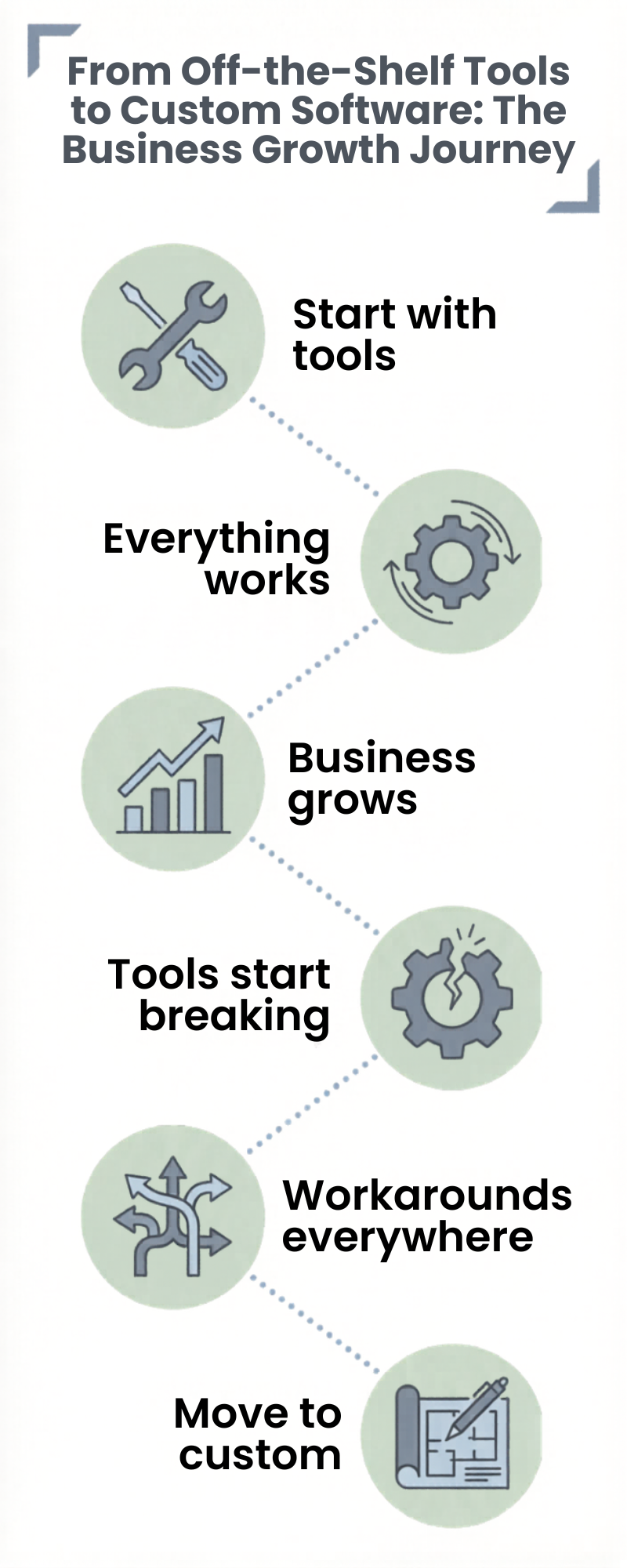
As your business grows, tools that once worked perfectly can start creating limitations—and that’s where the shift toward custom software begins.
When Should You Choose Which?
Up until now, we’ve been comparing custom software vs off the shelf. But the real question every business is asking is much simpler:
Which one should you choose?
Let’s break it down in a practical, no-fluff way.
When Should You Choose Custom Software?
So, when does it actually make sense to go custom?
- When software is your business
If you’re building a SaaS platform, a marketplace, or any kind of tech-driven product, your software isn’t just supporting your business… it is the business. In that case, going off-the-shelf just doesn’t cut it.
- When you need competitive differentiation
If everyone in your industry is using the same tools, then no one really stands out. Custom software gives you that edge—your own features, your own workflows, your own “secret sauce” that competitors can’t replicate.
- When your requirements are highly specific
Sometimes your processes are just too unique. Maybe you’ve got a complex internal workflow or a very niche use case. If you’re constantly trying to “hack” or force an off-the-shelf tool to fit… that’s usually a sign you need something custom.
- When you need full control
We’re talking control over features, updates, integrations, even security. With custom software, nothing is out of your hands. You decide what gets built and when.
- When there simply isn’t a suitable off-the-shelf solution.
Sometimes the market just doesn’t have what you need. And in those cases, custom isn’t a luxury—it’s the only option.
When Should You Choose Off-the-Shelf Software?
Now on the flip side, there are plenty of situations where off-the-shelf is actually the smarter move.
- When you need a quick solution
If speed matters—like launching a product, setting up operations, or testing an idea—off-the-shelf gets you there fast.
- When your needs are standard
Things like HR, payroll, CRM—these are common problems with well-established solutions. There’s usually no need to reinvent the wheel here.
- When your budget is limited.
Custom software requires upfront investment. If that’s not feasible right now, off-the-shelf lets you move forward without heavy costs.
- When you don’t have a development team
Building and maintaining custom software requires technical expertise. Without that, it can become more of a burden than a benefit.
- When the software isn’t core to your business
If it’s just supporting operations and not driving your competitive advantage, then it’s usually better to go with something ready-made.
The Hybrid Approach
The choice between custom software vs off the shelf isn’t always black and white.
In fact, in the real world, most smart businesses don’t pick one or the other.
They go with a hybrid approach.
What Does the Hybrid Approach Actually Mean?
Instead of building everything from scratch, or relying entirely on ready-made tools, you combine the best of both worlds.
You use off-the-shelf software for the common, standard features… the stuff that’s already been solved a thousand times.
And then you layer custom development on top for the parts that actually make your business unique.
So you’re not wasting time reinventing the wheel—but you’re also not limiting yourself where it matters most.
A Simple Example
Let’s say you’re running an eCommerce business.
You might use something like Shopify to handle the basics—your storefront, product listings, payments. All the standard stuff that works out of the box.
But then, instead of stopping there, you build something custom.
Maybe it’s a personalized recommendation engine that increases conversions.
Or a custom checkout flow tailored to your customers.
Or even a backend system that optimizes your operations.
Now suddenly, you’re not just another store using the same platform as everyone else—you’ve added your own edge.
Modern Trends Shaping the Decision
Now, before you make any decision in the custom software vs off the shelf debate, there’s one more layer we need to talk about.
Because the landscape today is very different from what it was even five or ten years ago.
There are some major trends shaping how businesses think about this choice—and if you ignore them, you might end up making a decision based on outdated assumptions.
The Rise of SaaS (Subscription Model)
Let’s start with the biggest shift.
Most off-the-shelf software today isn’t something you buy once and own. It’s SaaS—Software as a Service.
You pay a monthly or yearly subscription. The vendor handles hosting, updates, maintenance—everything.
On the surface, this sounds great. And in many ways, it is.
You always have the latest version. You don’t need an internal team to manage infrastructure. And you can scale relatively easily.
But here’s the trade-off.
You also give up a level of control and flexibility. You’re tied to the vendor’s roadmap, their pricing, and their limitations.
And over time, those subscription costs can quietly add up.
AI & Low-Code Development
Now, on the custom side, things are changing just as fast.
Building software is no longer as expensive or complex as it used to be.
With AI tools, low-code, and no-code platforms, businesses can now build and iterate much faster than before. What used to take months can sometimes be done in weeks—or even days.
This lowers the barrier to entry for custom software.
It means more companies can now afford to build tailored solutions, even without massive engineering teams.
Platform-Based Customization
Then there’s this middle ground that’s becoming incredibly popular.
Instead of choosing between fully custom or fully off-the-shelf, businesses are using platforms like Salesforce or Microsoft Dynamics.
These platforms give you a foundation—core features out of the box—but also allow you to build custom functionality on top.
So you’re not starting from scratch… but you’re also not stuck with a rigid system.
It’s customization without the full cost of building everything yourself.
Conclusion
So, where does all of this leave us?
If there’s one thing you should take away from this entire custom software vs off the shelf discussion, it’s this:
There is no one-size-fits-all solution.
There’s no universal “best” option. No single answer that works for every business, every industry, or every stage of growth.
Because at the end of the day, this decision isn’t really about software.
It’s about your business.
Your goals.
Your budget.
And where you’re trying to go next.
If you’re optimizing for speed and simplicity, off-the-shelf might be exactly what you need right now.
If you’re building something unique, something that sets you apart, then custom software might be the smarter long-term play.
And in many cases, the right answer is somewhere in between.
But here’s the final thought—the one that really puts everything into perspective.
If software is just supporting your operations, then yes, treat it like a cost. Keep it lean, efficient, and practical.
But…
If software is your competitive advantage—if it’s the thing that drives your growth, your customer experience, or your differentiation—
Then it’s not a cost.
It’s an investment.